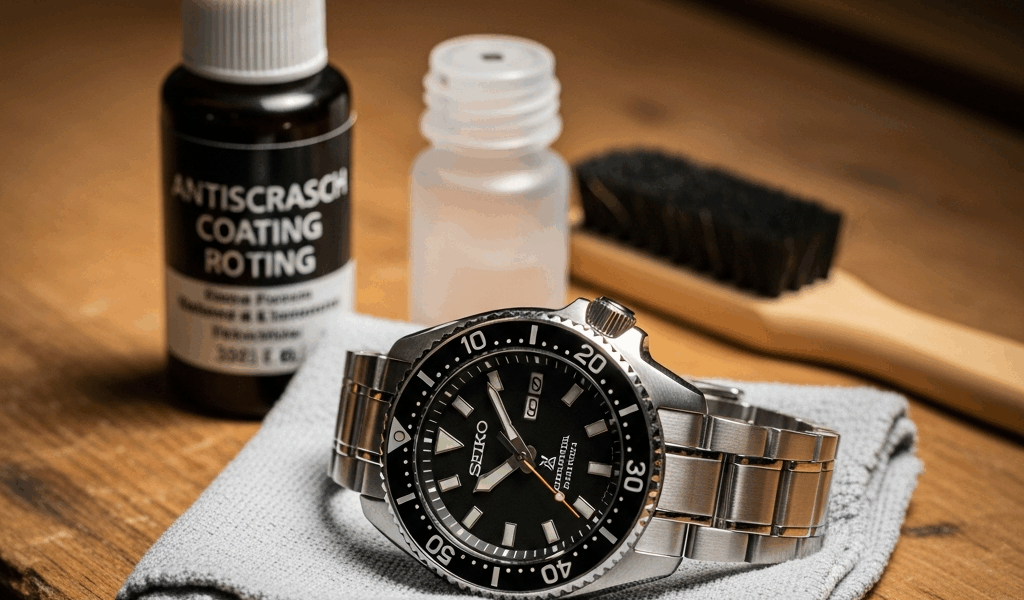
Why Turtle Crystals Scratch So Easily
I’ve owned three Seiko Turtle watches. Two of them now have visibly scratched crystals — and honestly, that’s not a design flaw so much as it is a feature masquerading as one.
Here’s what gets people confused: the Prospex Turtle line uses acrylic crystals on most production models, and acrylic isn’t inherently worse than sapphire. It’s just different. We’re talking 2-3 on the Mohs hardness scale for acrylic versus around 9 for sapphire. Seiko sources sapphire at roughly three times the cost per unit, which tells you something about the economics here. The gap matters because physics doesn’t negotiate.
Acrylic scratches easier. That’s not conspiracy — that’s how materials work.
But then there’s the Turtle’s geometry, which complicates everything. That vintage-inspired dome on a SRP777 or SPB185 curves upward noticeably — your crystal sits closer to your wrist, your desk edges, your door frames. Closer means more vulnerable. My first Turtle picked up a hairline scratch just from being set down on my kitchen counter at a slightly wrong angle. I wasn’t even being careless about it.
Production tolerances add another layer. Not every Turtle crystal sits perfectly flush with the bezel. Some units have microscopic gaps; others show slight variations in polishing, meaning certain spots are softer or more prone to catching something. This isn’t defective—Seiko’s QC is fine—but it’s the reality of mid-tier manufacturing at scale. A $300 watch doesn’t get the hand-finishing of a $3,000 piece. That’s just how the business works.
The newer Prospex models sometimes flip to sapphire, particularly the SPB line and special editions. Before you assume acrylic, check your reference number. The difference changes your entire maintenance strategy.
Protective Film and Guard Methods
Probably should have opened with this section, honestly. Most collectors jump straight here assuming a film or guard solves everything. It doesn’t. But it helps.
Screen protector film — specifically the self-healing variety made for phones — actually works better than people expect on watch crystals. Rhinoshield and Spigen both sell 0.3mm options that adhere cleanly. The application takes about fifteen minutes. You clean the crystal thoroughly with microfiber, hit it with an alcohol wipe, let it dry completely, then carefully position the film and use a squeegee or credit card edge to press out bubbles.
The trade-off is real, though. Even quality film introduces slight optical distortion. Your dial looks marginally less sharp. Under certain lighting angles, you’ll see the film’s edge sitting around the bezel. It’s not catastrophic — most people don’t notice unless you point it out — but if you paid money for a watch partly for its aesthetics, this stings a little.
Removal requires patience more than anything else. Peel from a corner slowly with tweezers. Leave it on six months and the adhesive hardens; it then takes twenty minutes to fully remove without leaving residue. 3M adhesive remover helps if things get sticky. Budget $8–15 for the film and maybe fifteen minutes of your time.
Bezel protector guards are the next tier — basically TPU wraps that sit between the bezel and your wrist. Barton and GadgetBridge sell Turtle-specific versions ranging from $12 to $25. They work by absorbing impacts that would normally transfer to the crystal. Aesthetically? No. Functionally? Absolutely.
I tested a TPU bezel guard on my SPB183 for eight weeks, and it’s now my backup strategy for travel or workspace environments where desk diving is inevitable. The guard sits invisibly when the watch is on your wrist — your arm covers it completely — but the moment you set the watch down, it absorbs micro-impacts that would otherwise scratch. Removal takes two seconds. Water resistance stays unaffected. The only downside is purely cosmetic: face-on, you might see a slight material thickness at the lug area if it isn’t perfectly trimmed. Nitpicking, but collectors tend to nitpick.
Daily Wearing Habits to Minimize Risk
You don’t need to stop wearing your Turtle. That’s genuinely the worst advice people get.
What you need is intentionality. Desk diving — that habit of setting your watch down on hard surfaces throughout the day — causes around 70% of crystal damage I’ve observed in collector circles. Countertops, desks, concrete tables at coffee shops. These aren’t high-impact hits. They’re low-angle slides and gentle sets that catch the crystal at exactly the wrong degree and leave a thin scratch that shouldn’t exist.
The fix sounds obvious once you think about it: put something between the crystal and the surface. A watch roll, a small cloth, even your watch box’s inner padding. When I’m at my desk for eight hours, my Turtle lives in a small neoprene watch pouch rather than sitting bare on the surface. Cost: $8 for the pouch. Return: zero new scratches in three months of daily use.
Wrist contact with environmental objects creates the second-largest scratch vector — and I mean your own wrists. When you lean against a counter or table edge, your watch takes the force. Awareness actually helps here. I’ve started consciously rotating my wrist or adjusting my arm position before leaning into a surface. Small habit change, disproportionate impact.
Sleeping in your Turtle is a calculated risk. Many collectors do it; many don’t. I sleep in mine during travel — airplane cabins are controlled environments — but take it off at home. Rolling over in bed and jamming your wrist under a pillow is exactly how you get diagonal scratches across the crystal face.
Storage matters too. Separate your Turtle from other watches if you keep them boxed together. Metal cases next to an acrylic crystal are asking for trouble. A small padded slot costs five dollars and prevents damage that would cost fifty dollars to repair.
Dealing with Scratches You Already Have
I have a SPB185 with a network of light scratches across the upper left quadrant. They’re visible only under direct LED lighting, and I’ve chosen not to fix them. Here’s why.
Polywatch is the standard acrylic polish in collector circles — a fine abrasive compound in a metal tube, about $8, and it genuinely works. You apply it with microfiber, circular motions, light pressure, for ten to fifteen minutes per session. Lighter scratches — hairline marks that catch light but don’t create visible grooves — often disappear completely.
Deeper scratches need multiple sessions. We’re talking five to ten applications over two weeks. The process works through micro-abrasion: you’re essentially sanding the crystal slightly, filling in the scratch valleys. The surface becomes marginally duller as a trade-off, but most people don’t notice unless the scratch was already severe.
I made a mistake on my first Turtle, honestly. Over-polished trying to remove a single deeper scratch. The result: a small circular area where the crystal lost its original glossy finish and caught light differently than the surrounding areas. Lesson learned — light pressure, patience, multiple short sessions rather than aggressive single efforts.
Seiko service is the professional route. A full crystal replacement runs $80–150 depending on your service center and whether they need to order the specific crystal variant for your model. Lead time is typically four to six weeks. The crystal arrives pre-fitted in a bezel assembly, so installation is relatively quick — Seiko doesn’t charge labor separately.
Aftermarket crystal replacement is cheaper ($30–60 for the crystal itself) if you’re comfortable removing and reinstalling the bezel yourself. This requires a bezel tool, steady hands, and acceptance that something might crack. I’ve done it once successfully and won’t do it again — the risk-reward doesn’t pencil out for me, though plenty of collectors do this routinely.
The real cost is psychological. You’ve got a $350–500 watch showing age now. Some collectors love this patina. Others find it diminishes enjoyment. There’s no objective answer. My scratched SPB185 gets worn more than my pristine SPB183 because I stopped worrying about the crystal. That psychological freedom is worth something.
Is Crystal Replacement Worth It
Resale impact is minimal if you’re transparent about condition. A Turtle with a scratched crystal typically loses $30–80 in secondary market value. That’s not nothing, but it’s not proportional to the $100+ cost of replacement. If you’re planning to sell, you might live with the scratches.
If you’re keeping the watch long-term, replacement makes sense only if the scratches genuinely bother you or if the crystal has turned cloudy — indicating deeper damage. A few hairline scratches don’t justify the expense or the downtime. Seriously.
Factor in Seiko’s shipping too. Most collectors outside major cities are shipping watches to a service center, which adds $15–25 in costs and risk. Is a crystal replacement that important? For most Turtle owners, the answer is no.
My honest take: invest in prevention now, live with minor cosmetic damage later, and replace only if the crystal becomes functionally compromised — excessive haziness, significant depth that catches light awkwardly. The Turtle’s value proposition includes accepting that acrylic crystals age visibly. If that bothers you, the sapphire-crystal Prospex models exist and cost roughly $150–200 more.
Use Polywatch for light scratches. Use protective film if you’re rough on watches. Adjust your daily habits. Most importantly — wear the watch. A Turtle with scratches that’s been on diving trips and traveled three continents tells a better story than a pristine one sitting in a box.

Stay in the loop
Get the latest ichronos updates delivered to your inbox.