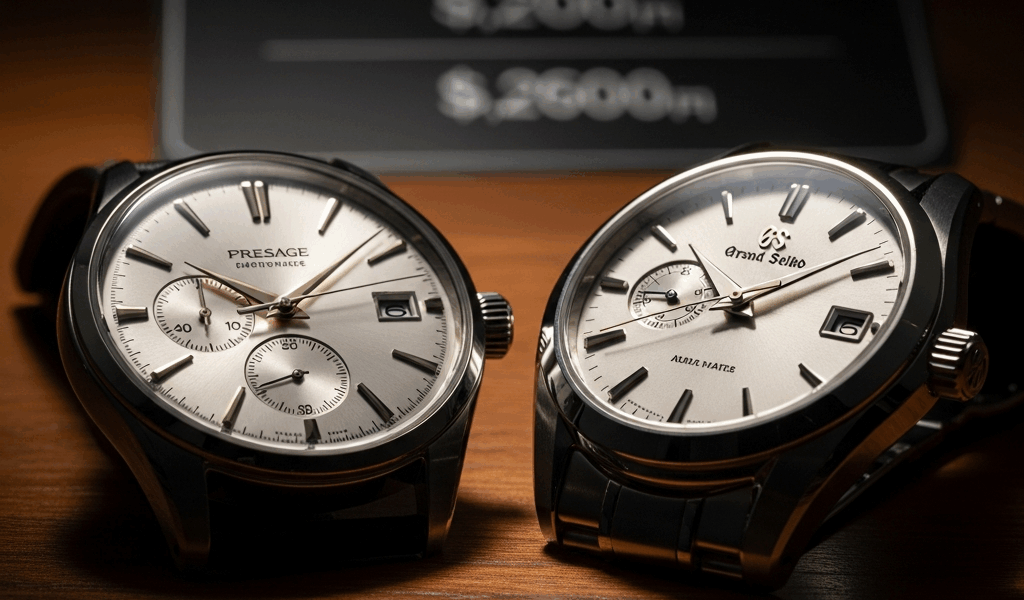
Seiko Presage vs Grand Seiko — Worth the Jump?
The Seiko Presage vs Grand Seiko debate has gotten complicated with all the reverent think-pieces and dismissive hot takes flying around. As someone who spent three months agonizing over this exact decision with $800 burning a hole in my watch budget, I learned everything there is to know about where these two brands actually diverge. Today, I will share it all with you.
I kept reading articles that either treated Grand Seiko like a religious experience or waved the Presage off as a starter watch. Neither framing helped me pick anything. So here’s the version I wish I’d found — dollar-anchored, honest about what the gap actually buys you, written for someone who just wants to wear a good watch.
What You Actually Get for the Price Difference
Numbers first. A Seiko Presage entry-level piece — something like the SRPB43 cocktail time series or the SRPE — runs $300 to $500 new. Grand Seiko’s entry point, typically the SBGP series or the SBGA211 “Snowflake,” starts around $1,800 and climbs fast. We’re talking $2,500 and beyond for the more desirable dials. That’s a $1,300 to $2,000 gap depending on which models you’re comparing.
What fills that gap? Four things, roughly in order of how much they matter to a daily wearer.
- Movement finishing. Grand Seiko movements are hand-finished in ways that Presage movements simply aren’t. Buy both and flip them over — you’ll see it immediately. The Presage caseback reveals a serviceable, clean automatic. The Grand Seiko caseback reveals something that looks like jewelry inside a machine.
- Dial quality. Grand Seiko dials are largely handmade, often using techniques specific to the Shizukuishi or Shinshu studios. The texture depth on a Snowflake dial has to be seen in person to understand. Presage dials are beautiful for the price — the enamel and cocktail dials especially — but they’re playing a different game entirely.
- Case finishing. Both brands do Zaratsu-style polishing. Grand Seiko just does it better. The mirror polish on a Grand Seiko case holds its definition in a way that Presage cases don’t match — not even close under strong lighting.
- Service costs. This is the one people forget, and it’s a real number. A Presage service runs $150–$200 at a decent independent watchmaker. A Grand Seiko factory service from an authorized center can hit $400–$600. Spread that over 15 years of ownership and it adds up to something you’ll actually feel.
None of this is to say Presage is cheap. At $400, it punches well above its weight. The gap is real, but so is the value on both sides.
Movement Quality Compared — 9SA5 and 4R35 Side by Side
Probably should have opened with this section, honestly. It’s where most buyers get tangled up in specs that sound impressive but don’t translate cleanly into daily wear.
The Presage typically runs a Seiko 4R35 or 6R15, depending on the reference. The 4R35 beats at 21,600 vph and is rated to +45/-35 seconds per day — that’s a wide tolerance. The 6R15 tightens things up to +25/-15 seconds per day. Both are reliable, proven, and cheap to service. I’m apparently a lucky owner and my 6R15-powered piece ran within 5 seconds per day for two straight years, so the rated tolerance is a ceiling, not a promise of mediocrity.
Grand Seiko operates in a different tier entirely. The 9SA5 — their flagship hi-beat automatic — beats at 36,000 vph and is rated to +5/-3 seconds per day. Their 9R Spring Drive movements, found in pieces like the SBGA211, use a regulation system unlike anything else on the market. It replaces the traditional lever escapement with a glide spring controlled by a quartz oscillator. The result: accuracy to ±1 second per day in real-world use. That’s closer to quartz than to most mechanical movements. There’s genuinely nothing else like it at this price range.
But what does that mean for a daily wearer? In essence, it means you’re choosing between “good enough” and “extraordinary.” But it’s much more than that. If you set your watch weekly and aren’t timing train departures, the 6R15’s +15 seconds per day is genuinely fine. If accuracy is your actual priority — not just a spec you like reading — Grand Seiko’s Spring Drive is the answer. The 4R35 won’t frustrate you either way.
Better movement finishing also means tighter manufacturing tolerances. Tighter tolerances generally translate to longer service intervals and more consistent performance over decades. That’s a functional argument for Grand Seiko — not just an aesthetic one.
Dial and Case Finishing — Where Grand Seiko Earns Its Price
Frustrated by every watch review’s vague hand-waving about “hand finishing,” I eventually drove to a dealer and handled both side by side under proper lighting. The difference is not subtle.
Zaratsu polishing is a hand-applied technique — you can identify it on the case flanks where polished and brushed surfaces meet in a perfectly sharp, distortion-free line. Grand Seiko applies this to every surface junction on the case. Presage cases have good finishing, genuinely good, but under magnification or strong side-lighting the polish transitions go soft. Less defined. That’s what makes Grand Seiko’s finishing endearing to us watch nerds — it’s the kind of thing you keep discovering months after purchase.
The dial work on Grand Seiko’s higher references uses textures inspired by Japanese landscapes — the Seasons collection out of Shinshu studio especially. The Snowflake’s layered frost texture creates genuine physical depth, not printed depth. Indices are hand-applied and polished individually. At $2,000-plus, you’re paying for something genuinely handmade in a way that a $400 Presage simply is not.
Here’s the honest part, though. These are aesthetic upgrades. A Grand Seiko does not keep time more visibly, sit more comfortably on the wrist, or survive a knock better because of its dial finishing. If you’re reading this paragraph and shrugging — that’s useful information. It means the price premium doesn’t buy you anything you actually value, and the Presage is your watch.
Who Should Buy the Presage Instead
Direct answer. No hedging.
- First dress watch buyers. If this is your first non-digital watch or your first step up from a fashion brand, buy the Presage. You don’t yet know what you want. Spending $400 to learn is smart — spending $2,000 before you understand your own preferences is a common mistake. I watched a friend buy a Grand Seiko SBGP001 and wear it twice before realizing he preferred casual watches. Don’t make his mistake.
- People spending under $600. The Presage is nearly peerless in the $300–$600 range. Nothing from Orient, Tissot, or Hamilton touches the dial quality of the Presage cocktail series at that price point. This is genuinely one of the best-value dress watches being made right now.
- Daily wearers who aren’t precious about watches. Office, airport security, occasional dinners — the Presage is the practical choice. You won’t spend mental energy calculating repair costs every time you set it face-down on a conference table.
- Small collection builders. If you’re building toward three to five watches across different styles, the $1,500 you save on a Presage versus a Grand Seiko entry piece funds another watch entirely. At this stage, breadth beats depth.
Final Verdict — Which One Should You Actually Buy
So, without further ado, let’s dive in on the actual answer.
Grand Seiko wins on movement refinement, dial artistry, case finishing, and long-term prestige. It is a better watch by most technical and aesthetic measures. The Spring Drive movements are engineering achievements with no real equivalent at the price — full stop.
The Presage wins on value, accessibility, service costs, and practical daily ownership. It delivers roughly 70% of the Grand Seiko experience at 20% of the price. That math is hard to argue with unless the remaining 30% — the finishing, the accuracy, the studio craftsmanship — genuinely matters to you. And for some people it does. For others it doesn’t. Neither answer is wrong.
Here’s the split, one sentence each.
- Daily wearer: Buy the Presage SRPB43 or SRPE, wear it hard, and don’t look back.
- Gift buyer with a $500 ceiling: Presage is the move — it looks more expensive than it is, and the recipient won’t know the difference for years.
- Collector stepping up from Presage who already knows what they want: The Grand Seiko SBGA211 Snowflake is worth every dollar of its $2,500 price tag — go get it.
The jump from Presage to Grand Seiko is worth making exactly once — when you’ve already owned a Presage, know you want more, and have the budget without stretching. Before that point, the Presage is just the smarter watch.


Stay in the loop
Get the latest ichronos updates delivered to your inbox.