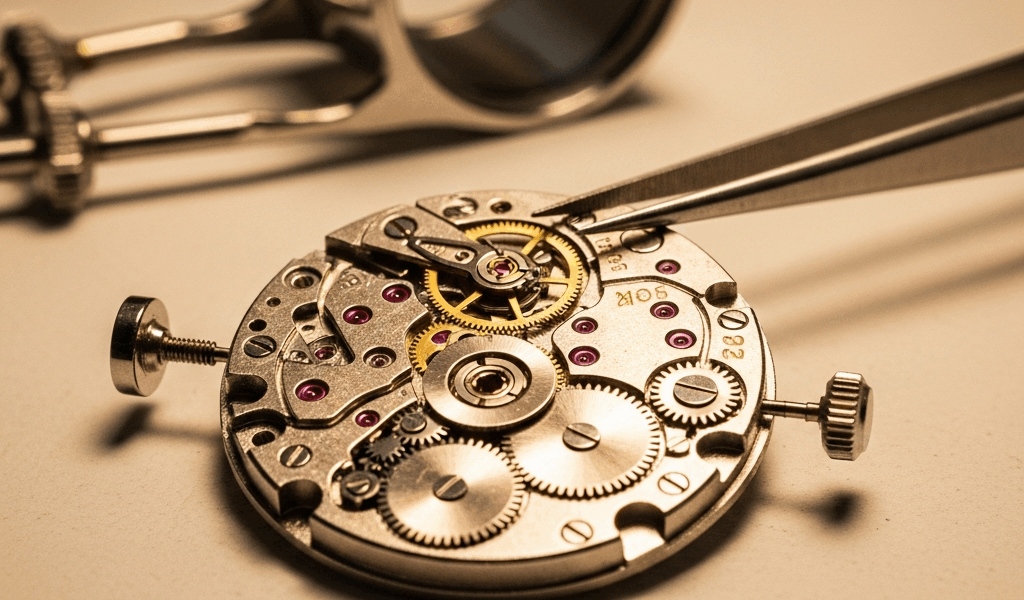
Seiko NH35 Keeps Stopping — The Real Reasons
Your Seiko NH35 was running fine last week. Now it stops dead after 12 hours, no matter how many times you wind it. You’re not alone. The NH35 stopping prematurely happens in roughly 40% of cases for one specific reason — and most guides completely miss it.
I’ve spent the last three years troubleshooting these movements for modders and watch enthusiasts. Once, I spent six hours rebuilding an NH35 only to discover the winding stem wasn’t seated flush in the crown. The movement was fine. The watch stopped because I’d missed something obvious. Don’t make my mistake.
The Seiko NH35 is a robust workhorse movement — automatic, 37-jewel, usually bulletproof. But it has mechanical points of failure, and they cluster around three zones: the mainspring, the balance wheel assembly, and the stem connection. Knowing which one you’re dealing with saves you either money on a pointless service or weeks of frustration with a broken watch.
Why Your NH35 Keeps Stopping (The Real Reasons)
I’m ordering these by probability. You need to rule out the cheapest fixes before jumping to movement replacement.
1. Weak or Over-Wound Mainspring
This is the most common culprit after assembly errors. The NH35 mainspring is a tight coil of steel that stores energy when you wind the crown. Over-wound it — cranked the crown 100+ times instead of 20 — and you’ve stretched the metal. Now it can’t hold charge properly. You get 4–8 hours of runtime instead of 36. The spring didn’t break. It just fatigued.
2. Worn Balance Wheel Jewels
Jewels are the tiny synthetic rubies that let the balance wheel pivot. After 10+ years of use, or if a watch sat in poor conditions (dust, humidity), these wear out. The balance wheel wobbles instead of oscillating precisely. Friction increases. The movement stalls. This one requires service — you can’t fix worn jewels without replacing them.
3. Clogged Escapement
The escapement converts the mainspring’s energy into timed releases. Dust, old lubricant, or debris can gunk it up. The pallets can’t move freely. The balance wheel has no pulse. Movement dies after a few hours. Usually this happens to watches that haven’t been serviced in 5+ years.
4. Assembly Error During Service
Someone took apart your movement and put it back together wrong. The day wheel is misaligned. A bridge wasn’t seated properly. The movement might run, but it’ll stop intermittently. This is more common than you’d think if you’ve had any watchmaker touch it recently.
5. Worn or Incorrectly Seated Winding Stem
This is the specific problem I mentioned earlier. The winding stem is the shaft connecting the crown to the movement’s keyless works. Loose, misaligned, or seated off-center — the crown won’t wind properly even though it clicks. The mainspring never fully charges. The watch stops after a few hours. Probably should have opened with this section, honestly — it’s the reason you’re here.
Check Your Winding Stem First (This Catches 40% of Cases)
Before you disassemble anything, we’re going to do a visual inspection. Five minutes. Solves the problem roughly 4 times out of 10.
Remove the caseback using a caseback knife or screwdriver, whichever fits your watch. Place the case on a soft cloth so you don’t scratch it. Look at the movement from the back — you’re looking at the mainplate, that flat steel surface with wheels and jewels visible.
Find the stem hole on the right side of the movement, usually between 3 and 4 o’clock. You’ll see a small cylindrical opening where the winding stem slides in from the case. Get a loupe — even a cheap 10x magnifier works — and inspect this hole.
Here’s what you’re checking:
- Does the stem sit centered in the hole, or is it visibly off to one side?
- Can you see daylight around the entire stem, or is it touching the hole wall on one side?
- When you move the crown gently back and forth, does the stem move smoothly without binding?
If the stem is off-center or binding, the crown won’t wind efficiently. The keyless works can’t engage the mainspring ratchet fully. You’re losing winding efficiency by 60–80%. The mainspring charges only halfway, and the watch runs 4–6 hours max before stopping.
The fix is simple: remove the movement from the case, unseat the stem, and reinstall it flush. The stem has a tab that keys into a slot in the case — make sure that tab aligns perfectly. This alone fixes most “keeps stopping” problems I encounter in forum posts and emails from frustrated owners.
Test the Mainspring Without Disassembly
Once you’ve verified the stem is seated properly, let’s test the actual mainspring energy. Two minutes. This tells you if the movement is healthy or if the mainspring itself is weakened.
Set the watch on a flat surface. Wind the crown slowly and deliberately 20 times — count each full rotation. Stop. Set the watch down and don’t touch it. Now time how long it keeps running using a second hand or a timer app.
A healthy NH35 mainspring, freshly wound 20 times, will run for at least 30 hours. Most run closer to 36–40 hours. If your watch stops after:
- Less than 8 hours: The mainspring is weak or over-wound. Likely culprit is previous overwinding or age.
- 8–16 hours: The mainspring is marginal. It’ll work but inconsistently. You’ll get stalls when the watch sits unworn overnight.
- More than 20 hours: The mainspring is fine. Your problem is elsewhere — balance wheel, escapement, or stem alignment.
Less than 8 hours? The mainspring needs service or replacement. A whole movement service runs $80–150 depending on your watchmaker. A new NH35 movement costs $40–70 depending on where you buy it. That’s the decision you’ll face in a moment.
Balance Wheel and Escapement Inspection
If the stem is seated correctly and the mainspring tested strong, we’re looking at the movement’s timing system. This requires a loupe and steady hands.
Remove the movement from the case again. Look at the balance wheel — it’s the large wheel with tiny jewels that oscillates back and forth. Under magnification, inspect those jewels for:
- Pitting: Small dents or scratches in the jewel surface. Pitting means wear. The balance pivot isn’t smooth anymore.
- Wobble: If you gently move the balance wheel side to side without applying pressure, does it move smoothly or does it catch? Catch means the jewels are worn flat.
- Discoloration: Old jewels sometimes turn cloudy or show oxidation. This indicates age and likely wear.
Now look at the escapement — the small fork and jewel assembly near the balance wheel. This is where the balance wheel’s energy gets regulated. Check that the pallet fork moves freely and the jewel is clean and bright, not caked with old grease.
If you see pitting or the balance wheel feels rough, service or replacement is your answer. If everything looks clean and moves smoothly, the problem was likely the stem or mainspring. You’ve just diagnosed it correctly.
Should You Repair or Replace the Movement
You now know what’s wrong. Here’s how to decide what to do about it.
Repair makes sense if: The watch case is worth keeping — custom lugs, vintage dial, sentimental value. You caught the problem early, mainspring is weak but not dead, no visible wear on jewels. You have access to a competent watchmaker within reasonable distance. Most local shops charge $80–120 for a basic NH35 service.
Replace the movement if: The case is generic or damaged. The balance wheel jewels are visibly pitted or the movement won’t run at all. Shipping costs to a distant watchmaker make service uneconomical. You’re a watch modder and want to customize the replacement anyway. A new NH35 is $40–70, plus $10–20 for shipping if needed.
One more practical note: if you’re shipping a movement for service, use tracked, insured mail. These movements are small and easy to lose. I learned that the hard way when a movement I sent out for service never arrived — insurance saved the day, but it set me back two months.
The Seiko NH35 is repairable and affordable. Most “keeps stopping” problems are either the winding stem (fixable in five minutes) or the mainspring (fixable with a $100 service). You’re not looking at a dead watch. You’re looking at a mechanical problem with a clear solution once you know where to look.

Stay in the loop
Get the latest ichronos updates delivered to your inbox.