Why Your Invicta Pro Diver Keeps Losing Time—And What’s Actually Happening
I own three Invicta Pro Divers. The first one, a 2019 model I grabbed for $165, started losing about 8 minutes a day by year three. The second one? Still bulletproof after five years. The third one arrived already magnetized from the factory — which, honestly, was frustrating. So when you’re searching for why your Invicta Pro Diver keeps losing time, you’re looking at one of three specific mechanical failures, not some mysterious defect. Budget dive watches from Invicta are genuinely solid entry-level pieces, but they’re not immune to the physics that govern all automatic movements. Let me walk through what’s actually breaking inside that case.
Why Invicta Pro Divers Lose Time Most Often
Diving into collector forums and Reddit threads, the same failure patterns repeat constantly. Three culprits dominate the conversation: mainspring degradation, water intrusion into the movement, and magnetization from everyday metallic contact.
Mainspring wear is the heavyweight champion of accuracy loss. I learned this the hard way with my first piece. The mainspring — that long metal ribbon coiled inside the barrel that powers your watch — gradually loses its ability to deliver consistent force after years of winding and unwinding. Invicta uses ETA-sourced movements in most Pro Divers, typically the ETA 2824-2, which are solid, but the mainspring quality varies by production batch. A degraded mainspring doesn’t unwind evenly. So the watch gains or loses time throughout the day depending on how much power remains in reserve. By year three or four, owners commonly report 5-15 minutes of daily loss, and it accelerates from there. One collector on WatchUSeek documented his Pro Diver losing 22 minutes daily by month 36 of ownership.
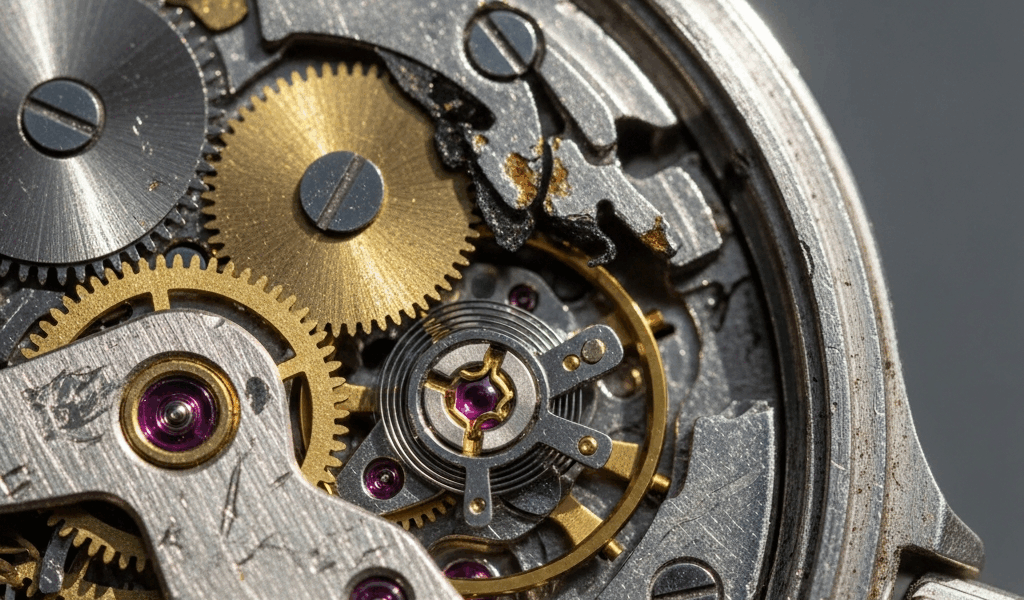
Water damage hits faster than mainspring issues. A failed gasket — those tiny rubber rings that seal the caseback — lets moisture creep past the screw-down crown and into the movement. The movement sits directly under that crystal. Once condensation reaches the balance wheel, the hairspring (a gossamer-thin spiral regulating oscillation), or the escapement, friction increases dramatically. The balance wheel can’t swing freely, so timekeeping fractures immediately. Some owners report sudden jumps of 10-20 minutes of loss within weeks of visible fogging under the crystal.
Magnetization is sneakier than both. Your watch spends all day near your phone, laptop, car dashboard, and leather furniture with metal clasps. Ferrous particles in the movement — primarily the balance spring — gradually pick up residual magnetic fields. Once magnetized, the spring no longer returns to its natural frequency. It oscillates faster or slower than design spec. A magnetized Pro Diver might lose 30 seconds daily or gain 45 seconds. The bizarre part? The loss isn’t consistent. You’ll notice it varies by how close you sleep to your phone, or after a day at the gym near electrical equipment.
How to Check If Your Movement Is Magnetized
Before you spend $100 on a service, run this test. Probably should have opened with this section, honestly.
Download a compass app on your smartphone — I use Digital Compass by Smartphoneware; it’s free and reliable. Power it up and let it calibrate for 30 seconds. Set your watch flat on a table, face up. Open the compass app. Slowly move the phone in a circle around your watch, keeping it about 2-3 inches away. If the compass needle spins erratically, swings back and forth unnaturally, or points toward the watch instead of geographic north, you’re holding a magnetized movement.
You can also use a physical compass if you have one — dollar stores sell basic ones for $3-5. Same principle: place it near your watch, then move it around the case. A magnetized watch will deflect the compass needle toward itself.
Why does this work? Magnetized metal components generate a localized magnetic field strong enough to throw off a navigation compass. Your balance spring, escapement wheel, and regulating lever all contain ferromagnetic materials. When they’re magnetized, the magnetic field becomes measurable and obvious.
If the compass responds normally around your watch, magnetization isn’t your problem. Move on to water damage inspection or mainspring testing.
Gasket and Seal Failure Signs to Spot
Water damage leaves evidence behind. Crack open your caseback — gently, with a caseback opener (mine cost $12 on Amazon) — and only if you’re comfortable with it. Look for any of these signs:
- Condensation under the crystal. This is the earliest warning sign. Fogging that comes and goes with temperature changes means moisture is inside the case but hasn’t reached the movement yet. You’re in the window to act before the movement corrodes.
- Discoloration on the movement bridges. Oxidation appears as light rust, purple-brown staining, or white chalky deposits on the brass or steel components. Once you see this, corrosion has eaten into the surface.
- Stiff date wheel or sticky hands. Water causes the lubricant on gear teeth to thicken and gum up. If your date wheel clicks reluctantly or your hour hand drags, moisture is present.
- Visible water droplets on the balance wheel area. This is critical. Once droplets coat the hairspring, accuracy collapses within days.
I pulled apart my first Pro Diver after noticing fogging and found light corrosion on the barrel. The gasket under the crown had deteriorated — it was rigid and cracked instead of pliable rubber. Invicta’s OEM gaskets are adequate but not premium. They degrade faster than gaskets on Seiko or Citizen equivalents, especially if you expose the watch to temperature swings or store it in humid environments.
The timeline matters. Condensation under the crystal typically appears 2-4 weeks after gasket failure begins. Corrosion reaches the movement bridges within 4-8 weeks. Timing loss accelerates as rust adds friction to gear engagement. By week 12, you’re looking at 30+ seconds of daily loss, sometimes more.
DIY Fixes That Actually Work vs Waste of Time
Let’s separate the real solutions from the YouTube rabbit holes.
Demagnetization works. Full stop. A demagnetizing coil costs $25-45 online. The principle is straightforward — you run an AC current through a coil that generates a decreasing magnetic field. Place your watch inside (the coil generates no heat), let it cycle for 20-30 seconds, and the movement’s magnetization resets to zero. I demagnetized my second Pro Diver after importing it and never had issues. You can also send it to a watchmaker for professional demagnetization ($80-120 labor), but the DIY coil pays for itself after one use.
Mainspring replacement requires a watchmaker. Don’t attempt this yourself unless you’ve already serviced dozens of movements. The mainspring sits in a barrel under significant torque. Removing it without proper tools risks snapping the spring or injuring your hands. A mainspring swap costs $60-100 at an independent watchmaker, $120-180 at a certified service center. You can source OEM ETA mainsprings online for $8-12, but labor dominates the cost.
Gasket replacement is a DIY maybe. If you’re comfortable opening the caseback, you can swap out the crown gasket yourself. Genuine Invicta replacement gaskets run $4-8. The caseback gasket requires slightly more precision — you need a thin, flat tool to pry out the old gasket and set the new one evenly. I’ve done it twice on my pieces. The risk is misaligning the gasket so water still seeps in. First attempt? Expect a 30% chance of failure. Second attempt? Maybe 80% success rate. Not terrible odds for a $4 part.
“Cleaning the movement with rubbing alcohol” is a waste of time. Yes, it removes some corrosion. No, it doesn’t restore accuracy. Rust has already pitted metal surfaces. Alcohol cleans surface oxidation but can’t undo dimensional damage. Save your money.
Shock and vibration adjustment myths. Some forums suggest banging your watch or dunking it in hot water to “reset” the movement. This is nonsense. You’ll either dislodge something (breaking accuracy further) or do nothing. Don’t do this.
When to Repair vs When to Accept the Loss
Here’s the collector math I’ve learned from experience. An Invicta Pro Diver retails around $150-200, though street prices often hover at $100-140 if you wait for sales. On the secondary market, a well-kept example sells for $80-130.
If your watch is 2-3 years old and exhibits mainspring degradation — slow, gradual loss of 8+ minutes daily — sinking $100 into a mainspring service puts your total investment at $200-240 in a watch that secondary markets value at $100. That’s a collector’s choice: you either keep it because you’re emotionally attached, or you accept the loss.
Water damage repair is trickier. A full service — including disassembly, ultrasonic cleaning, movement inspection, new gaskets, lubrication, and reassembly — runs $120-180 at a reputable independent watchmaker. For a $150 watch, that’s an 80%+ cost recovery. Only pursue this if the watch has sentimental value or if you’re running the numbers on a rare reference (like the older 8926OB, which commands $180-250 used).
Magnetization repair? That’s a no-brainer. A $30 demagnetizing coil solves the problem permanently. Even professional demagnetization at $100 is justified because the fix is final and the watch will run true afterward.
My own decision: I serviced my first Pro Diver ($110 total for mainspring replacement) because I’d worn it daily for three years and it held sentimental value. My third watch, magnetized on arrival, I demagnetized myself ($30 tool). My second watch, still running strong, I’ll never touch unless it fails. That’s the realistic approach for budget collectibles — treat each piece individually based on what it means to you, not what spreadsheets suggest.


Stay in the loop
Get the latest ichronos updates delivered to your inbox.