Why Seamaster Crystals Scratch and When Replacement Matters
I’ve owned four Seamasters across fifteen years. The first one—a 2008 Planet Ocean—came back from a beach trip with a crystal so scratched that looking through it felt like peering through frosted glass. Omega sapphire crystals are genuinely tough, rated 9 on the Mohs hardness scale. Sand isn’t. But here’s what most owners don’t realize: the damage pattern tells you whether you actually need to replace it.
Pre-2005 Seamasters used acrylic crystals. Softer. Scratch easily. Actually polish out sometimes with the right compound. Modern Seamasters switched to synthetic sapphire, which scratches from specific culprits: direct sand contact, careless polishing, accidentally bumping the watch crystal-first into a sink edge. It happens.
The real question is functional versus cosmetic. A scratch directly in your sight line when reading the dial? That’s worth fixing. A few light surface scratches around the edge? Honestly, I left those alone for two years before getting annoyed and paying for replacement. The crystal still sealed perfectly. Water resistance didn’t change. But the cosmetic irritation eventually won.
Acrylic crystals develop cloudiness over decades — that yellowing effect you see on vintage watches. Sapphire stays crystal clear indefinitely, which is partly why Omega switched. If you inherited a 1970s Seamaster and the crystal looks like aged plastic, replacement transforms the watch visually.
Official Omega Service Cost Breakdown
Pricing varies wildly by model and your location. I called three Omega boutiques in different US regions to get current numbers.
Seamaster Diver 300M crystal replacement through official Omega service runs $385–$520 depending on your regional distributor. That’s parts plus labor. The Diver 300M uses a specific stepped crystal design that Omega doesn’t sell separately to independent watchmakers, so you’re locked into their supply chain.
Planet Ocean models sit at $420–$580. The older ceramic bezel models sometimes require bezel work during crystal replacement, which bumps it higher. A 2015 Planet Ocean I had serviced came back at $545 because they re-glued the bezel sapphire inlay while they had the crystal out.
Seamaster Professional (pre-2012 models) typically costs $350–$445. The newer co-axial models with different case construction run $475–$620.
Vintage Seamaster crystal replacement — anything pre-1990 — becomes a specialty service. Omega charges $550–$750 because they’re sourcing period-correct acrylic and potentially hand-finishing the fit. Their vintage department handles these specifically.
Here’s what Omega won’t tell you upfront: shipping to their service center costs $15–$25 depending on insured methods. Turnaround is typically 6–8 weeks, though I’ve seen 3–4 weeks during slow seasons. Rush service doesn’t exist for crystal-only jobs. They batch your watch with others in their queue.
You also get an international warranty on the completed service — usually 2 years on the crystal itself and any gaskets they replace. That’s worth factoring in.
Independent Watchmaker Pricing and Pros/Cons
Frustrated by Omega’s pricing, I took my 2012 Seamaster to an independent certified watchmaker in my city who specializes in vintage and modern dive watches. The difference was immediate: $225 for the crystal plus $85 labor. Total $310. Three-week turnaround instead of six.
Independent watchmakers typically charge $200–$350 for Seamaster crystal replacement, labor included. Some source OEM Omega crystals; others use aftermarket sapphire blanks that are optically identical but cost them significantly less. The fit and finish matter more than the source.
The red flag: if someone quotes $120 total for a Seamaster crystal job, they’re either cutting dangerous corners or don’t understand Seamaster construction. Proper crystal work includes gasket replacement, bezel inspection, and water pressure testing. That takes time.
Finding a good independent watchmaker requires homework. Check forums — WatchUSeek and Rolex forums have reliable recommendation threads. Ask for references. A competent independent will happily show you their certifications (American Watchmakers-Clockmakers Institute, British Horological Institute) and let you speak with previous clients.
The warranty trade-off stings though. Most independents offer 6–12 months on their work, not Omega’s 2-year guarantee. If the crystal fogs up from internal moisture six months later, you’re buying it again or contacting them for warranty work. Some will redo it free; others charge partial labor.
One more consideration: if your Seamaster is relatively new and still under Omega’s international warranty, taking it to an independent might void the warranty for unrelated issues. Omega’s official policy states that unauthorized service can affect warranty coverage. It’s not always enforced, but it’s the official stance.
Can You DIY a Seamaster Crystal Swap
I attempted this once. Once. Never again.
Probably should have opened with this section, honestly. DIY Seamaster crystal replacement is technically possible but practically a nightmare for most owners. Here’s why.
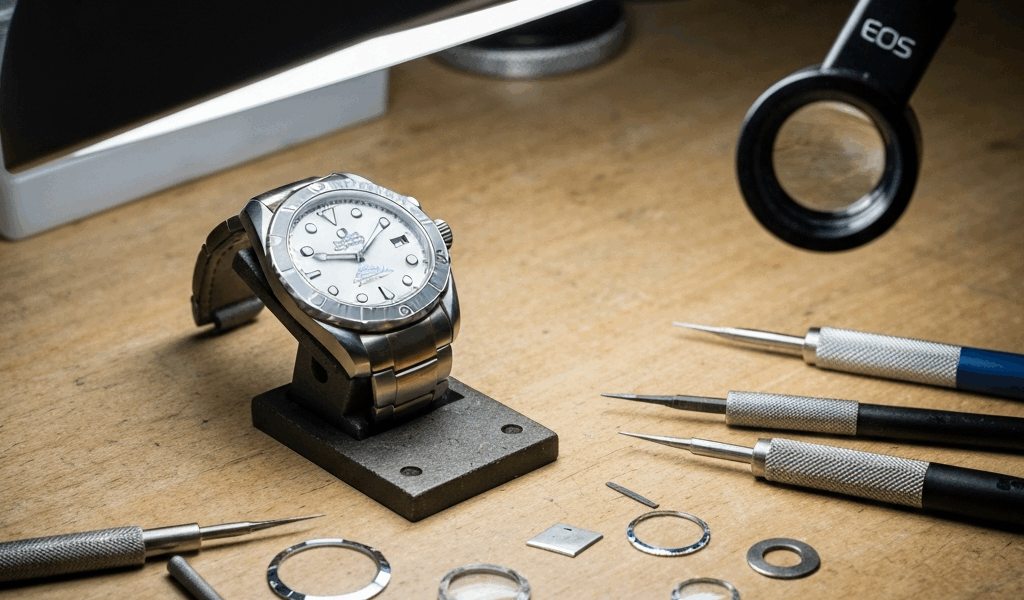
You need specific tools: a crystal lifter tool (not a flathead screwdriver, despite what random internet posts suggest), a case opener for screw-back cases, gasket material, petroleum jelly, and ideally a watch loupe to inspect the crystal seat. Total tool cost: $60–$120 if you’re buying quality. One-time cost, sure, but most owners never do another crystal replacement.
The difficulty varies by Seamaster generation. Newer Diver 300M models with pressed crystals are hardest. The crystal sits in a metal ring that’s slightly press-fitted into the case. You have to gently pry it out without scratching the case lug or crushing the gasket groove. One slip sideways and you’ve gouged your case.
Older Seamasters with screwed bezels are slightly easier because you remove the bezel first, reducing risk. But older acrylic crystals sometimes bonded to the case over decades — forcing them out can crack the crystal itself or damage the acrylic rim where it seats.
The gasket sealing is where most DIY attempts fail. New crystals need a new gasket — usually a thin rubber O-ring. You have to clean the gasket seat (dried residue from the old one), fit the new gasket precisely, and ensure even pressure when you re-seat the crystal. Too loose and water gets in. Too tight and you crack the new crystal.
Water pressure testing is the final hurdle. You can’t just assume it’s sealed. A failed DIY job that passes your bathroom sink inspection might leak at depth. Professional testers use pressure chambers — equipment you don’t own.
Cost of a failed DIY attempt? You’ve lost the new crystal ($40–$80). You’ve potentially damaged the case ($200–$800 repair cost if the lugs got gouged). You’re now paying a watchmaker to fix your mistake plus do the job correctly ($400–$600). The math is brutal.
I dinged my case rim slightly on my second attempt and spent $380 having a watchmaker redo everything properly. The crystal itself cost me $35. The education cost me $345.
Our Recommendation Based on Your Situation
Here’s my decision tree, built from real experience.
Newest Seamaster under Omega’s international warranty (within 5 years)? Go official. The warranty coverage protects you. Omega service is premium, but it’s also the safest path if something goes wrong. You’re not risking your investment.
Vintage Seamaster, pre-1980s? Independent watchmaker who specializes in vintage watches. Omega’s vintage service charges museum prices for older models, and frankly, an experienced independent will preserve the watch better. They care about the history.
Mid-range modern Seamaster, 6–10 years old, out of warranty? This is where independent watchmakers shine. You’ll save $150–$300, get faster turnaround, and the risk profile is reasonable if you’ve vetted the watchmaker properly. Get references. Check certifications.
The crystal is purely cosmetic damage — light surface scratches, no functional impact? Honestly? Live with it. Especially if you wear the watch regularly. New scratches will appear within months. You’re chasing a standard the watch won’t maintain. I made peace with cosmetic marks years ago.
DIY crystal replacement? Only if you’re a watch enthusiast who already has tools and experience with case opening. Even then, the risk-to-reward calculation is poor. You’re saving maybe $200 against a potential $500+ mistake. That’s not a gamble worth taking with a Seamaster.
The collectible angle matters too. If you’re keeping the Seamaster long-term or might sell it later, the service history affects value. An official Omega service card in the watch box is worth money. An independent watchmaker’s work is documented less formally, which could matter to future buyers, especially if it’s a popular model.
My 2008 Planet Ocean, serviced officially five years ago, now has that service card in the box. When I eventually move it, that documentation adds credibility and likely increases its resale value. The preventive cost of official service is partially offset by that intangible but real collector premium.


Stay in the loop
Get the latest ichronos updates delivered to your inbox.