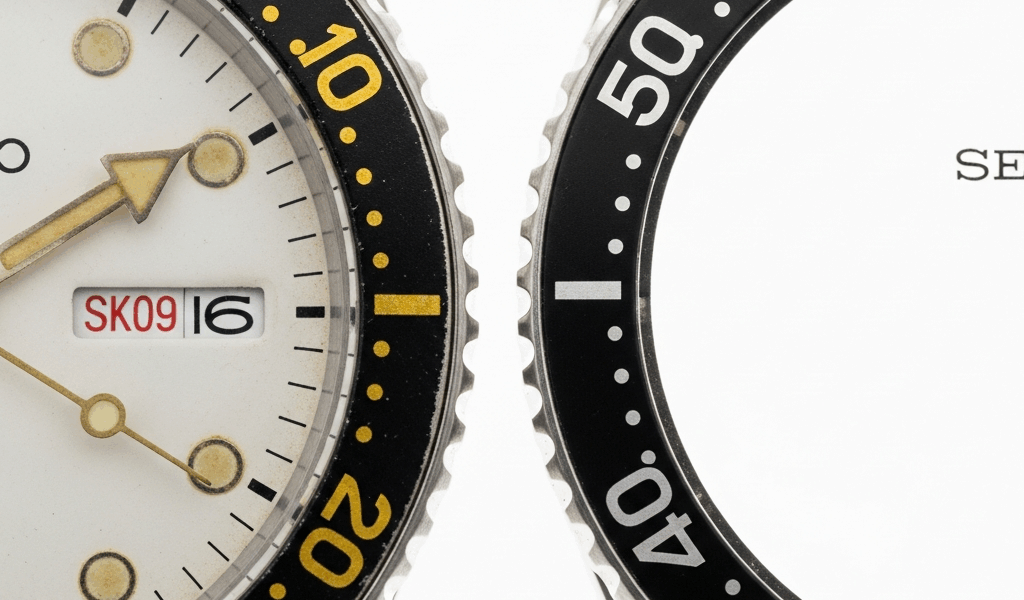
Why SKX009 Bezels Fade Faster Than Other Seiko Models
The Seiko SKX009 bezel insert fading problem has gotten complicated with all the forum noise flying around, but I’ve spent enough time in watch forums and swap meets to understand exactly why. As someone who’s owned three SKX009s over the past eight years—including one that sat in a beach bag for an entire summer—I learned the hard way that this isn’t random degradation.
The SKX009 uses a printed aluminum bezel insert, not ceramic. This matters enormously. What is a printed aluminum insert? In essence, it’s a layer of UV-sensitive ink applied directly onto aluminum, then sealed with a clear lacquer coating that degrades predictably under sun exposure. But it’s much more than that. Compare this to the SKX007, which uses similar construction, but the SKX011 shifted to a thicker printed insert with better light-fastness around 2008. The SKX009 never got that upgrade.
Age accelerates everything. A 1999 SKX009 sitting in a collection today has 25 years of molecular breakdown happening regardless of use. The clearcoat yellows. The printed colors—that deep blue, the white hour markers—they bleach out from the inside first, creating a ghosted appearance rather than uniform fading. I’ve seen examples where the bezel face looks washed out while the rest of the watch is pristine. That’s what makes this particular fade pattern endearing to watch enthusiasts who’ve dealt with it.
Storage conditions matter more than most people admit. A watch kept in a desk drawer under standard indoor fluorescent lighting fades slower than one kept near a window. UV-A light penetrates glass. A watch displayed on a sunny shelf can fade noticeably in six months. One stored in a dark watch roll? That same watch might take five years to show comparable fade.
UV Light and Salt Water Exposure — The Real Culprits
Direct sunlight is the primary driver. The SKX009’s printed bezel insert lacks UV stabilizers that ceramic inserts have inherently baked into their molecular structure. When UV rays hit that lacquer coating, they break polymer chains. The blue fades to gray-blue within months of regular summer diving or beach wear. The white marker lines yellow slightly before fading to cream.
Salt water compounds the problem significantly. Frustrated by inconsistent rinsing habits, I wore my first SKX009 to the Caribbean for two weeks straight—diving daily, rinsing about 40% of the time—and the bezel started showing visible fade after that trip alone. Salt crystals can trap beneath the lacquer coating and create micro-corrosion that weakens the adhesion between the printed insert and the aluminum beneath. The clear coat cracks microscopically. Water penetrates. Fading accelerates from there.
Realistic timelines vary wildly depending on usage patterns. A diver wearing the SKX009 twice monthly in tropical waters will see noticeable fade in six to eight months. Someone wearing it casually in temperate climates, maybe twice weekly—looking at fade becoming obvious after two to three years. A watch worn maybe five times yearly, kept away from direct sun? That might stay vibrant for seven years or more.
Fresh water rinsing helps, but it’s not a cure. The damage happens on the lacquer surface before salt dries. You need immediate freshwater flushing—ideally within two hours of salt exposure. Most divers don’t do this. Most forget. Most just accept the fade as part of the tool watch lifecycle.
How to Prevent Bezel Fade Right Now
Here are the tactics I’ve found actually work, ranked by effort-to-benefit ratio. Without further ado, let’s dive in.
Store in darkness
Cheapest intervention. Zero cost if you already own a drawer or watch roll. Keep the SKX009 in a dark environment when not wearing it — at least if you want meaningful preservation. Not a closed box in direct sunlight, but actual darkness. A watch box sitting on a closet shelf gets maybe 80% of the UV reduction compared to a box in a drawer. This alone extends the fade timeline by years. I’ve seen a 2002 SKX009 that spent its entire life in a desk drawer look nearly factory fresh, while a 2005 model that lived on a shelf aged noticeably in eight years. That gap is real.
UV-protective watch case
Cost: forty to one hundred twenty dollars depending on quality. Cases with UV-blocking clear front panels exist specifically for this purpose. Brands like Pelican make military-grade options, but watch-specific solutions from companies like Everest or Wolf are cheaper and more practical — both run around $60-$85. The SKX009 sits loosely in any standard watch roll with UV-protective lining, and that cuts UV exposure by roughly 95%. This is my recommendation for anyone actively diving or spending extended time outdoors with the watch.
Avoid prolonged sun exposure during storage
Don’t display it on a windowsill. Sounds obvious. Most people ignore this. A watch on a dashboard or windowsill during work hours gets the same UV intensity as a watch being actively worn, except passively. I moved my SKX009 from a sunny desk to a covered box, and the fade rate dropped dramatically — the difference was almost shocking within just five months.
Freshwater rinse after salt water
Costs nothing except discipline. Immediately after diving or beach wear, rinse the entire watch—case, bezel, bracelet—under fresh running water. Let it air dry. This removes salt crystals before they set and cause micro-damage. Do it within an hour if possible. This won’t prevent fade from UV alone, but it prevents the accelerated degradation that salt causes.
Bezel Insert Replacement Options and Real Costs
Probably should have opened with this section, honestly. It’s what most people searching for this topic actually want to know.
DIY insert swap
Difficulty: High. Risk of failure: 40% if you’re untrained. The aluminum insert is glued to the bezel ring with a contact adhesive that’s extremely difficult to remove cleanly. You need to heat-gun the bezel carefully, use a flathead to pry the insert without scratching the bezel itself, clean the adhesive completely, then glue the new insert back on with perfect alignment. If the alignment is off by even 2 millimeters, the bezel action becomes gritty. If you overheat the bezel ring, the plastic deforms. New inserts run $15–$40 from aftermarket vendors like Yobokies or DLW. You’ll spend two hours on the job and have maybe a 60% chance of a clean result on the first attempt. I’ve done this twice. Once perfectly. Once I needed to start over completely — don’t make my mistake. Only attempt this if you’re genuinely comfortable with potentially destroying a $200+ watch.
OEM Seiko replacement
Cost: Seiko charges roughly $45–$65 for the complete bezel assembly with the insert already glued to the ring. Labor to swap it runs another $40–$60 at an authorized dealer. Total comes to $85–$125. Turnaround time is typically two to three weeks. This is the safest option. Seiko’s OEM inserts match the original finish exactly, and the work is guaranteed. You lose the watch for a month. You pay more. But zero risk of mistakes.
Aftermarket ceramic inserts
Cost: $25–$45 for the insert itself. Installation requires the same DIY process. Ceramic inserts might be the best option, as bezel longevity requires genuine durability. That is because they won’t fade, they’re harder, and they age beautifully. The trade-off: they don’t match the original printed aesthetic exactly. A ceramic insert looks slightly different in tone and texture than the factory aluminum printed insert. Some collectors love this—it signals the watch has been serviced, modernized. Others hate it. A ceramic insert changes the watch’s character. It’s no longer factory original, which matters for resale value among purists. Vendors like Yobokies and Crystal Times make quality ceramic options. I’ve used them on beaters and they’re excellent. On a collectible SKX009? I’d stick with OEM.
Living With a Faded Bezel — When to Replace vs. When to Accept
Here’s the reality that forum posts never address directly: some collectors are fine with bezel fade. Some aren’t. There’s no objective answer.
A lightly faded bezel—where the blue is slightly washed out but the numbers are still crisp—doesn’t affect functionality. The watch reads time perfectly. The bezel still clicks reliably. The fade is cosmetic. If you wear the watch regularly, this patina tells a story. It shows the watch has been used, trusted, taken diving. Some people find that beautiful.
A heavily faded bezel—ghosted markers, illegible numbers, yellowed face—affects the watch’s utility and aesthetic appeal. You can’t read the timing as cleanly. The watch looks neglected rather than vintage.
Resale impact depends entirely on the buyer. A collector buying a 1999 SKX009 with significant bezel fade will negotiate the price down $30–$60. Some collectors expect and accept fade on watches this age. Others view it as a defect. A recently faded SKX009 (less than three years old with obvious fade) loses more value because it signals poor storage or handling. Why did this young watch fade so quickly? That question makes buyers nervous.
Practical framework: if the bezel is less than 30% faded and you wear the watch actively, accept it. That’s tool watch patina. If the fade is severe and it bothers you visually, replace the insert with OEM—the cost is minimal relative to the watch’s total value. If you’re planning to sell within the next two years, replacement makes financial sense if the fade is noticeable. If you plan to keep it indefinitely, the decision is purely aesthetic.
I keep my most faded SKX009—the Caribbean diver—exactly as it is. The bezel is pale blue, almost gray now. The watch still works perfectly, and the fade feels earned. My second one, which showed unexpected fade in just three years from a sunny desk, I replaced with an OEM bezel. That watch sits in a dark drawer now. Both decisions were right for their specific context.

Stay in the loop
Get the latest ichronos updates delivered to your inbox.