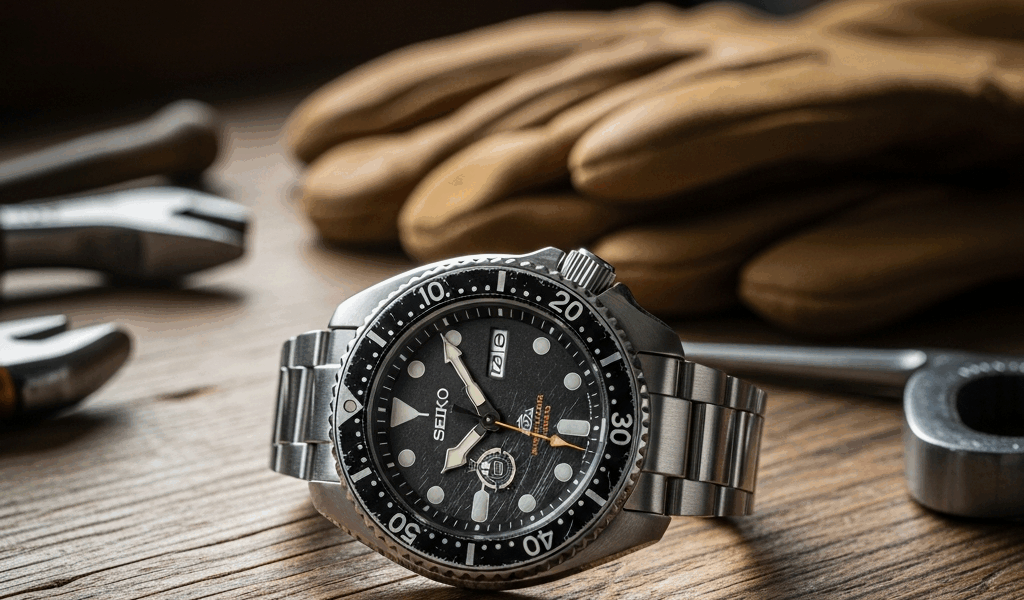
What Makes the SRP777 Different from Other Seiko Divers
Seiko’s diver lineup has gotten complicated with all the SKX nostalgia and Prospex upmarket noise flying around. As someone who has spent three years wearing the SRP777 through offices, travel, and everything in between, I learned everything there is to know about this cushion-case workhorse. Today, I will share it all with you.
But what is the SRP777, really? In essence, it’s a 45mm automatic diver sitting inside Seiko’s Prospex line with an asking price of $250–$350. But it’s much more than that. The story starts with that case shape — the “turtle” silhouette that turns heads without trying to. Unlike the SKX007’s round, almost textbook-classic proportions, the Turtle’s lugs are integrated, rounded, almost sculpted. Stockier. Retro without being costume-y. That’s what makes the Turtle endearing to us diver-watch people.
The numbers on paper: 45mm diameter, 52mm lug-to-lug, 13mm thick, 200m water resistance. The 4R36 movement inside runs 24 jewels, hacks, and hand-winds. The bezel is unidirectional, coin-edge, 40-click. No grinding. No play. Functional in the way a good tool should be — quietly, without asking for praise.
Frustrated by the SKX007’s discontinuation and ballooning secondary-market prices, a lot of watch buyers started looking sideways at the Turtle around 2018. This new favorite took off in forum circles several years later and eventually evolved into the cult object enthusiasts know and obsess over today. So, without further ado, let’s dive in.
How It Actually Wears Day to Day
The 45mm case reads large. No softening that statement. On a 7.25-inch wrist — just shy of average — it sits proud. The cushion shape absorbs some of that visual bulk, honestly, but you will feel this watch’s presence.
Probably should have opened with this section: if you have wrists under 6.5 inches, walk away. Try the SRP827 Prospex Turtle instead — smaller, more refined, also more expensive. Neither choice is wrong. Just honest about what you’re getting into.
Where comfort actually lives is that 52mm lug-to-lug. The watch wraps without overhang. I wore the stock rubber strap for the first week — stiff, serviceable, completely uninspired. Swapped it out for a $12 black NATO from a random Amazon seller and the watch transformed. Lighter feel, better drape, more personality. The 20mm lug width means you’ll never run out of affordable strap options. I’m apparently a fabric-strap person and the NATO works for me while the OEM rubber never really did.
Don’t make my mistake — avoid the jubilee-style steel bracelet if you can. It adds bulk, feels hollow, and rattles in a way that will quietly drive you insane. This watch shines on straps. Full stop.
The black dial on my version runs a deep sunburst finish — almost oil-slick under conference room lighting. Lume is adequate. Not the premium Super-LumiNova stuff you get on a $600 Tudor, but it charges fast and glows for hours without requiring a ritual stare-down. The bezel clicks with authority. Each of the 40 clicks feels deliberate. After three years, zero play, zero grinding. That was not guaranteed at the $280 price point, but here we are.
The 4R36 Movement — Reliable or a Concern
Probably should have opened with this section, honestly. The 4R36 is what splits opinion on this watch harder than anything else.
Here’s what it does right. It hacks — meaning the second hand stops when you pull the crown, which makes precise time-setting actually possible. It hand-winds smoothly, so a missed day of wear doesn’t force a full crown-spin marathon. Beats at 21,600 per hour. Reliability is, genuinely, rock solid. Three years. Zero failures. Zero service visits.
Here’s where it struggles: accuracy. Seiko’s specification says –20 to +40 seconds per day. Mine runs consistently at around +25 seconds. Within spec, technically. Still drifts noticeably by Thursday if you set it Monday. I’m apparently a weekly-winder and that works for me, but if sub-10-second daily accuracy matters to you, this movement will frustrate you — at least if you’re the type who checks against your phone constantly.
Temperature does things to it. Cold January weeks push it slow. A warm August nudges it fast. That’s mechanical watchmaking, not a defect. The higher-end Prospex references use the NH35 or NH36, which run tighter. That’s where Seiko reserves their precision. The 4R36 isn’t the choice you make because accuracy obsesses you — it’s the choice you accept because the rest of the watch absolutely justifies it.
SRP777 vs the SKX007 — Which One to Pick
The SKX007 is discontinued. That was 2018. Any one you find now on the secondary market runs $400–$600, and you’re inheriting unknown service history, potentially degraded gaskets, and a seller’s word about water resistance integrity.
The SKX007 has a round case — the classic dive-watch silhouette that purists prefer. Its lug-to-lug measures 47mm, making it wear smaller. Same 200m rating. Same movement family. The bezel is sharper, thinner, beloved by people who grew up with those old references. I get it.
The SRP777 trades that roundness for the cushion shape, picks up 5mm of lug-to-lug, and arrives new with a warranty and a receipt. Current retail sits around $280. Gray market — reputable vendors like Seiya Japan or authorized eBay dealers — runs $220–$250 on a normal day. That gap matters when you’re also budgeting a decent strap.
Pick the SRP777 if you want it new, under warranty, available tomorrow, and under $300. Pick the SKX007 if you’ve already found one at a fair price from a trusted seller and don’t mind the service gamble. Don’t spend $500 on SKX nostalgia when a better-available alternative exists for $250. Don’t make my mistake.
Should You Buy the SRP777 in 2025
Yes — at least if you’re comfortable with a 45mm footprint on your wrist, want a daily diver that won’t ask for a second mortgage, and prefer straps over bracelets. The price is fair without feeling like a clearance compromise. The bezel works. The case wears better in person than the spec sheet suggests. The lume is honest. The whole thing just holds together.
No, if you have smaller wrists, demand near-chronometer accuracy, or need the latest movement architecture Seiko offers. The SRP827 might be the best option in that case, as the Prospex line requires that refinement bump for certain buyers. That is because the 4R36 remains the SRP777’s one genuine limitation — functional, durable, but not precise enough for everyone.
While you won’t need a watchmaker on retainer, you will need a handful of decent straps and the willingness to set the time weekly. Buy from an authorized dealer or a reputable gray market source — Seiya Japan, Crystaltimes, Tokyo Time. Pair it with fabric or rubber. Set it Sunday nights. Wear it hard.
After three years, I haven’t regretted mine once. That’s the only review metric that actually matters.

Stay in the loop
Get the latest ichronos updates delivered to your inbox.