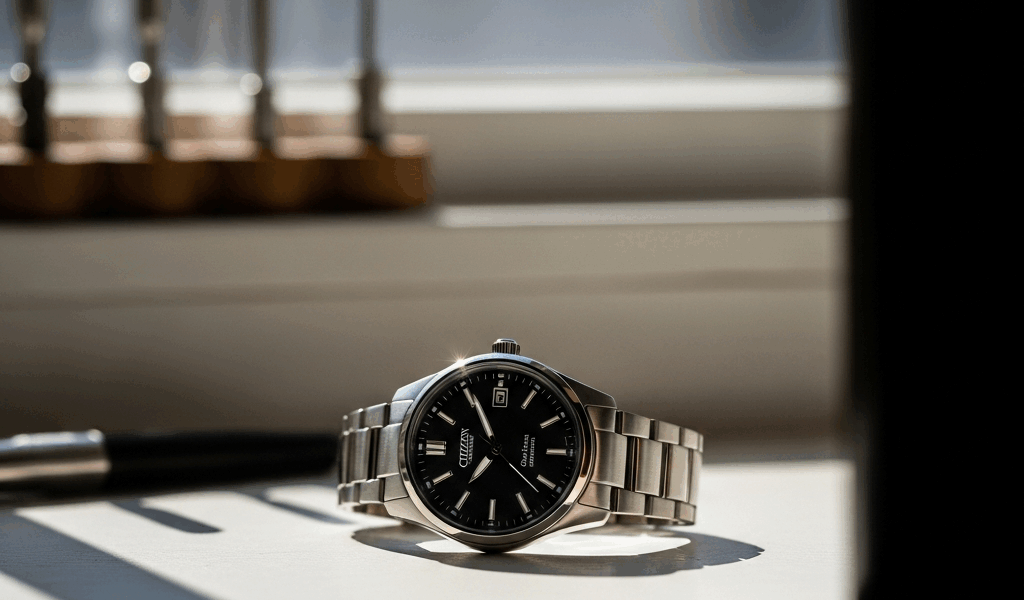
If a Citizen Eco-Drive watch stopped, identify its caliber number, open the matching Citizen manual, and charge it for the manual’s specified recovery time before assuming it needs repair. A deeply discharged model may take far longer than a few hours to restart or reach a full charge. Warning-hand movement, reset procedures, and charging times differ by movement.
Guide basis: This is an independent troubleshooting guide using Citizen’s published support information. iChronos does not claim ownership or hands-on testing of the reader’s watch. The case-back caliber and official manual control.
Citizen Eco-Drive stopped: quick diagnosis
| Symptom | Likely next step |
|---|---|
| Watch was stored in darkness | Charge under safe bright light for the caliber-specific time |
| Second hand moves unusually or at intervals | Check the manual’s insufficient-charge warning |
| Watch restarted but time or calendar is wrong | Set it using the exact caliber instructions |
| Hands do not align after charging | Check whether the caliber requires reference-position correction or an all-reset |
| Stops again soon after a documented full charge | Request inspection by Citizen or an authorized service provider |
| Moisture, impact damage, corrosion, or heat damage | Stop DIY troubleshooting and obtain professional service |
1. Find the caliber number before following instructions
Citizen manuals are organized by caliber. Look on the case back for the movement or caliber code, then use Citizen’s support search. Watches that look similar can use different movements, controls, warning behavior, radio reception, calendar systems, and reset sequences.
Do not follow a random crown-and-button sequence from a forum video. An all-reset intended for another caliber can create additional time, calendar, or reference-position problems.
2. Charge it safely
Place the dial where it receives bright light, following the manual’s charging table. Sunlight is generally more effective than ordinary indoor lighting, but charging time depends on illuminance, weather, window glass, dial exposure, and the specific movement.
Avoid excessive heat. Citizen warns against charging at high temperatures and against placing the watch too close to hot lamps. Do not leave it on a vehicle dashboard or another surface that can become very hot. Keep the watch dry unless its water resistance and current condition support the exposure.
There is no universal “two hours” or “five-to-eight hours” fix. Citizen’s tables often distinguish among the time needed to start moving, the time needed for one day of operation, and the much longer time needed to charge an empty cell fully.
3. Understand the low-charge warning
Many Eco-Drive calibers use unusual second-hand movement to indicate insufficient charge, commonly movement at multi-second intervals. The exact behavior is caliber-specific. A warning pattern generally means the watch still needs charging, not that the movement is mechanically destroyed.
Some functions may stop or become unreliable during low charge. Continue charging according to the manual before judging radio synchronization, chronograph, alarm, calendar, or other complications.
4. Set the time only after adequate charging
A watch that restarts may show the wrong time or date. Use the official setting procedure. Radio-controlled or satellite-synchronized models may need a manual time-zone setting, signal reception, or a reference-position check.
If the hands point to the wrong positions even though the movement is running, search the manual for “reference position,” “zero position,” or “all reset.” Perform those procedures only when the matching manual instructs you to.
5. Test whether it retains charge
After following the full-charge guidance, wear or store the watch under normal conditions and observe it. If it stops again unusually quickly, the cause may include inadequate charging, a rechargeable-cell problem, abnormal power consumption, or another movement fault.
Do not buy a generic “capacitor” and open the case as the first repair. Citizen Eco-Drive watches use caliber-specific rechargeable energy-storage components, and opening the case can affect seals, contamination control, warranty, and water resistance. A qualified service provider can test charge retention and movement consumption.
When charging is not the right fix
Arrange service instead of continued light exposure when:
- the watch shows internal condensation or water entry;
- the crystal, crown, pushers, or case are damaged;
- the watch stopped after a hard impact;
- the crown or buttons bind or fail to operate normally;
- it becomes excessively hot;
- it will not restart after the manual’s recovery procedure; or
- it repeatedly stops soon after a proper full charge.
Common troubleshooting mistakes
- Using one charging time for every Eco-Drive: caliber tables differ.
- Calling every storage cell a capacitor: use the part terminology and number for the movement.
- Charging with damaging heat: more heat is not more useful light.
- Resetting before charging: a low-charge condition can prevent proper operation.
- Assuming two-second movement is universal: confirm the warning pattern in the manual.
- Opening the case without water-resistance testing: seal condition matters after service.
How to contact service efficiently
Record the case-back model and caliber, purchase information, approximate age, last known full charge, charging conditions tried, warning-hand behavior, and any exposure to impact, moisture, magnets, or heat. This is more useful than saying only that the battery is dead.
Ask whether the evaluation includes rechargeable-cell capacity, movement power consumption, seals, pressure testing where applicable, and a written estimate before paid work.
Frequently asked questions
How long does a dead Eco-Drive take to charge?
It depends on the caliber and light level. Use the official charging table; the time to restart is not the same as the time to reach full charge.
Can an Eco-Drive charge under an indoor lamp?
Many models can, but ordinary indoor light is usually much slower than bright daylight. Prevent heat buildup and follow the manual’s distance and temperature warnings.
Why is the second hand moving every two seconds?
On many calibers this is an insufficient-charge warning. Confirm it in the manual for the specific movement and continue safe charging.
Does an Eco-Drive need a battery replacement?
It uses a rechargeable energy-storage cell rather than a disposable watch battery. If it no longer retains charge, have the correct component and movement tested professionally.
Where is the official manual?
Use Citizen’s global support center and search by the caliber number engraved on the case back.
Reviewed August 1, 2026. Caliber-specific Citizen instructions supersede this general guide.

Stay in the loop
Get the latest ichronos updates delivered to your inbox.