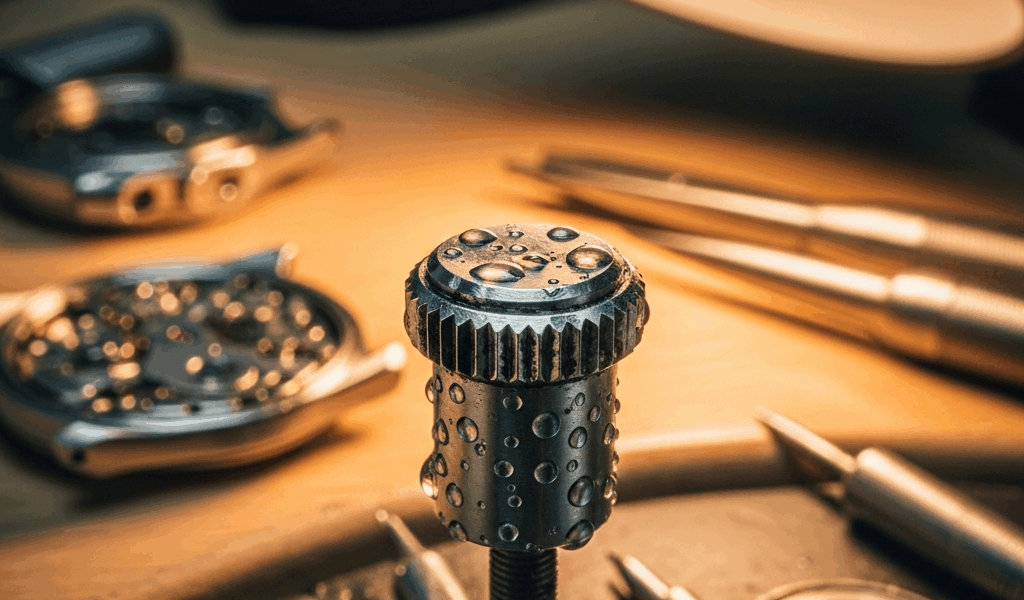
Why the SKX007 Crown Fails More Than You Think
SKX007 crown problems have gotten complicated with all the misinformation flying around watch forums. As someone who has owned three SKX007s over the past eight years — and watched the first one start leaking within eighteen months of regular diving — I learned everything there is to know about crown failure. Today, I will share it all with you.
But what is the crown, exactly? In essence, it’s a small threaded component doing two completely different jobs simultaneously. But it’s much more than that. It controls the stem — your gateway to winding, setting the date, and adjusting time — while also sealing the case against water intrusion. On the SKX007, that crown tube is a known weak point. Threads strip. Gaskets fail. The stem itself can slip inside the tube. Not all crown problems are identical, and misdiagnosing yours will waste $80 to $150 at a watchmaker or lead to a botched DIY attempt that costs even more.
What makes the SKX007 specifically vulnerable? The crown tube on heavily used examples wears faster than you’d expect. The gasket material Seiko used in older production runs deteriorates in saltwater and UV exposure. And aftermarket crowns — the cheap ones flooding eBay for $8 — rarely have gaskets matching original specifications. The tube diameter is 4.5mm. The stem is 1.9mm. Those numbers matter when you’re ordering a replacement.
Crown Will Not Screw Down Properly
Probably should have opened with this section, honestly. This is the first crisis most SKX007 owners face, and it’s the most fixable problem — at least if you catch it before water gets in. You pull the crown out, go to screw it back in, and it catches halfway. Grinds. Won’t seat flush against the case.
Start with diagnosis. Open the caseback using a case knife — the SKX007 uses a friction caseback, not screws, so don’t go hunting for a screwdriver. Look at the crown tube from inside the case. Is it damaged? Stripped? Bent? If the tube looks intact, the problem is usually the crown itself or the threads. So, without further ado, let’s dive in.
The Debris Fix
Debris causes roughly half of these failures. Salt residue, lint, old gasket fragments. Grab a soft brass brush — an old toothbrush works fine in a pinch. Scrub the threads on both the crown and the tube. Do this under running water or with a damp cloth. Dry completely. Then try screwing the crown back in by hand, slowly. No force. If it seats now, you caught it early. That’s the best possible outcome here.
The Gasket Check
Look at the groove on the underside of the crown. That’s where the gasket lives. Is it there? Intact? A hardened gasket looks gray and brittle — almost like a tiny rubber band that’s been sitting in a junk drawer since 2009. A missing gasket explains everything. You’re screwing bare metal into bare metal. No amount of cleaning fixes that. You need a replacement crown with a fresh gasket.
When You Need a New Crown vs. a New Crown Tube
If the crown threads look shredded inside the tube, the tube is the problem — replacing just the crown accomplishes nothing. Crown tube replacement requires removing the stem and movement. That’s a watchmaker job. Budget $80 to $150 depending on your location and who you trust with it.
If the crown itself is damaged or the gasket is shot, a replacement crown runs $25 to $60 from reputable suppliers. Test-fit it first. Screw it in by hand three times before committing. Does it catch? Grind? Cross-thread? Send it back without hesitation.
Crown Feels Loose or Spins Without Engaging
This is a different beast from the screw-down problem. You pull the crown out and it feels sloppy. Spins freely. Doesn’t grab the stem. The movement isn’t responding to winding or time-setting at all.
Two culprits: a stripped stem or a worn click spring inside the crown tube. The stem is the metal rod living inside the tube. The click spring is a tiny leaf spring holding the stem in place at each position. Only one of these is remotely a DIY fix — and even then, barely.
What You Can Check Without Opening the Case
Pull the crown to the first position — that’s date-setting. Does it click and hold? Try the second position for time-setting. A functioning click spring provides real resistance. You’ll feel it immediately. If both positions feel mushy with no click, the spring is probably worn through.
Does the stem spin freely inside the tube even with the crown fully pushed in? That’s stem slippage. The clutch mechanism connecting the stem to the crown tube is stripped. Different problem, same destination: a watchmaker’s bench.
Why DIY Ends Here
Fixing either issue requires removing the movement and partially disassembling the crown tube assembly. While you won’t need a full watchmaker’s toolkit, you will need a handful of specialized tools — a movement holder, quality tweezers, a new click spring or stem, and the knowledge to reassemble without cross-threading the tube back onto the movement. Don’t make my mistake. I tried this once on my second SKX007 with a YouTube tutorial and a $12 parts kit. Cost me an additional $180 to have a watchmaker undo what I’d done. You’re looking at $100 to $200 for a professional repair — but the SKX007 movement is tough and genuinely repairable. It’s worth every dollar.
Moisture Inside the Case After Crown Trouble
Condensation under the crystal. A foggy dial. Rust-colored moisture near the date window. That’s your SKX007 telling you the crown seal failed — and it happened a while ago, not yesterday.
Stop wearing it immediately. Don’t press the crown. Don’t dive it. Saltwater inside the case accelerates rust on the balance wheel and hairspring faster than most people realize. The movement may still be salvageable, but every additional day on the wrist makes recovery harder and more expensive.
Short-Term Damage Control
Place the watch in a sealed container with uncooked rice or silica gel packets. Leave it for three to five days. This won’t eliminate internal moisture completely — don’t expect miracles — but it slows rust formation while you arrange a proper repair. Don’t leave it longer than a week. You want some air circulation inside the case eventually.
Then take it to a watchmaker. A professional will open the case, rinse the movement in deionized water, dry it under controlled heat, and replace any corroded components. Cost: $150 to $300. Considerably cheaper than sourcing a replacement 7S26 movement, which runs $60 to $100 just for the part — assuming you find a clean one.
Replacing the Crown Yourself — What You Need to Know
Frustrated by two crown failures and approximately forty-seven conflicting forum threads, I eventually installed replacement crowns myself using nothing fancier than a case knife, a brass brush, and a lot of patience. Here’s what actually matters.
OEM vs. Aftermarket — The Reality
Genuine Seiko replacement crowns cost $35 to $50. They fit. The gasket is correct. They work for another five to ten years without drama. Aftermarket crowns from eBay or Amazon? $8 to $15. I’m apparently someone who learns through repeated failure — Seiko OEM works for me while cheap aftermarket crowns never seem to. I’ve installed three of them across my SKX007s. One worked fine. Two stripped the tube threads within months. Do the math on that savings.
Where to Buy
Reputable sources include Seiko’s official parts retailers, established watchmaker suppliers like Esslinger, and trusted sellers on WatchUSeek forums who specialize specifically in SKX parts. Check reviews. Ask about gasket material and specifications before purchasing. If the seller can’t answer basic questions about what they’re selling, don’t buy. That’s a simple rule that saves real money.
Installation Steps
- Open the caseback with your case knife. Set the movement aside on a clean microfiber cloth — not a paper towel, not a t-shirt.
- Inspect the crown tube threads one more time. Clean with a brass brush if needed.
- Insert the new crown slowly by hand. Feel for resistance at every quarter-turn.
- Screw it in until it seats flush against the case. Do not force it. You’re not tightening a lug nut.
- Test the positions. First click for date. Second click for time. Pull-out position. All smooth?
- If everything works, close the caseback. If it doesn’t, remove the crown and check for cross-threading before trying again.
When to Stop and Call a Professional
If the crown tube is damaged, stripped, or bent — watchmaker. If the stem is loose or the click spring is worn — watchmaker. If you’re not comfortable opening the case at all — definitely a watchmaker. A crown replacement at a reputable shop runs $60 to $120 labor-inclusive. That’s cheap insurance on a watch that will outlive you if treated right. That’s what makes the SKX007 endearing to us dive watch enthusiasts — it’s genuinely tough, genuinely repairable, and genuinely worth caring for properly. Diagnose first. Don’t guess.

Stay in the loop
Get the latest ichronos updates delivered to your inbox.