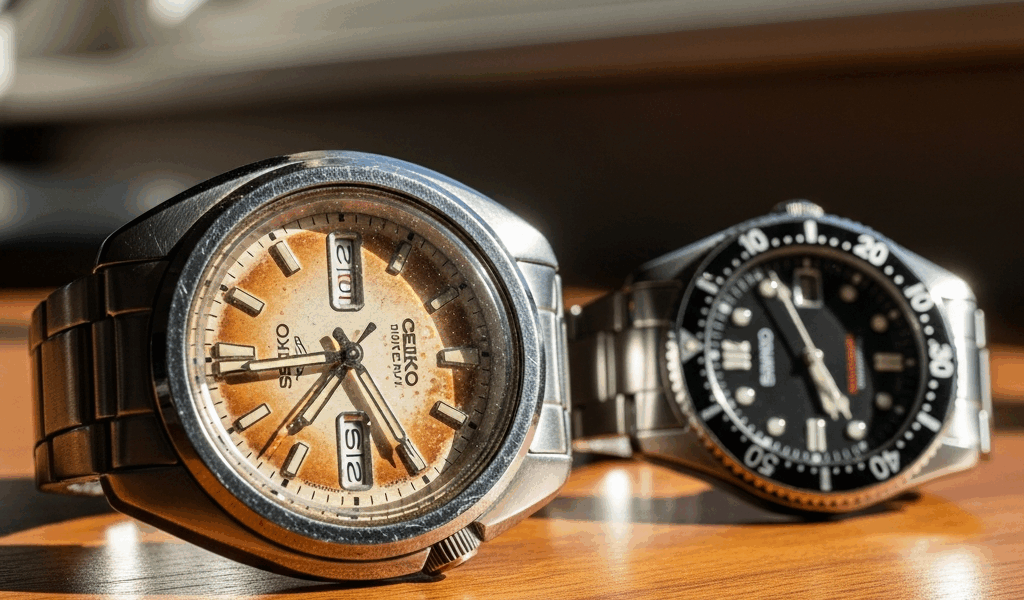
What the SNK809 Actually Is in 2025
The Seiko 5 SNK809 has gotten complicated with all the nostalgia and misinformation flying around. As someone who spent three years wearing one daily before eventually selling it, I learned everything there is to know about this watch. Today, I will share it all with you.
But what is the SNK809? In essence, it’s a budget mechanical field watch from the early 2000s that got discontinued and became a cult object. But it’s much more than that. You cannot walk into an authorized Seiko dealer and buy one new anymore — hasn’t been possible for years in most major markets. People still hunt used listings, new old-stock finds, forum threads debating whether the chase is even worth it.
The case is stainless steel, 37mm across. Inside sits the 7S26 automatic — a caliber that does not hack, does not hand-wind, and runs somewhere between -20 and +40 seconds per day on a good week. Applied indices on a minimalist dial. It feels like something built before watches needed Instagram marketing to justify their existence. That’s what makes the SNK809 endearing to us field watch people.
How It Wears Day to Day
Probably should have opened with this section, honestly.
Thirty-seven millimeters sounds modest until you put it on. On a six-inch wrist, the lugs overhang just slightly. On a seven-inch wrist, it lands exactly right. This matters more than any spec sheet suggests. Most used examples come on a canvas NATO — replace it immediately. The hardware tarnishes around month four. The canvas frays by month six. Budget somewhere between $30 and $50 for a decent aftermarket NATO or leather strap. Worn Horse, Crown and Buckle, something like that. Don’t make my mistake and assume the stock strap will grow on you.
Legibility varies wildly depending on light. Under office fluorescents, the dial reads clean — enough contrast, indices doing their job. Direct sunlight is another story. The polished bezel reflects hard and glare becomes a genuine annoyance. Not a dealbreaker, just something you adapt to after a week or two.
The lume situation is grim. I learned this the hard way during a late-night hike outside Asheville in 2019 — couldn’t read the time beyond arm’s length. The hands glow for maybe forty seconds in darkness before becoming useless. If low-light readability matters to your actual life, look elsewhere. Seriously.
The 7S26 Movement — Good Enough or a Problem
No hacking. No hand-winding. So, without further ado, let’s dive into why that actually matters in 2025.
The 7S26 relies entirely on wrist motion to wind. Remove the watch before bed — it stops. Skip wearing it for two days — you lose time and have to reset. I logged my SNK809 for six weeks straight and averaged roughly +18 seconds per week. Consistent drift, not random chaos. For a watch you check against your phone anyway, that’s barely noticeable. For someone needing chronometer precision, it will drive you insane.
The no-hacking thing creates a genuinely annoying ritual. You shake the watch to wind it, spin the crown to a rough time estimate, then sync against your phone. Takes maybe ninety seconds. Still, it’s 2025 — hand-winding and hacking feel like minimum expectations now, not luxury features.
Against competitors at the same used price — a Casio MDV-106 runs around $50 new and offers better lume and a bombproof case for outdoor work. An Orient Bambino sits around $130 and includes hacking, hand-winding, and a movement Seiko doesn’t match at this price tier. The SNK809 loses on paper. It trades those conveniences for something harder to quantify: a charm that predates the era when every watch needed to justify itself with a feature list.
What Has Aged Badly and What Still Holds Up
The bracelet deteriorates. Any used SNK809 with the original metal bracelet will show surface scratches and loose end-links — the finish wears unevenly and the whole thing looks tired by year three. Strap swap solves it practically, but the original presentation is just gone at that point.
The C3 lume — never excellent when new — is now genuinely weak on any example made before 2010. Modern watches run tritium tubes or Super-LumiNova that glows for hours. The SNK809 glows for minutes. That’s not a defect, it’s just age doing what age does.
I’m apparently hard on watch crystals and the stock mineral on my SNK809 picked up a hairline scratch within eight months. A $15 aftermarket sapphire swap — the SKX007 variant fits with minor modification — fixed that permanently. Small detail, big difference.
What actually endures: the dial. The applied indices have genuine character. The case finishing demonstrates competent execution for the price bracket. The bezel rotates without slack. Twenty years after production and the watch still runs — that deserves real respect, not hedged compliments.
The community matters too. Forum threads, modification guides, strap pairing recommendations — all of it accumulated over two decades. You are not experimenting alone when you own one of these. That network has tangible value.
Should You Buy the SNK809 in 2025
A used SNK809 might be the best option for your first mechanical watch, as the learning curve requires a low-stakes environment. That is because understanding service intervals, winding behavior, and accuracy expectations costs less emotionally when the watch itself cost $150 rather than $1,500.
Buy it as a modification platform. The aftermarket ecosystem is mature — sapphire crystals, modified dials, upgraded hands, NATO straps in every conceivable color. You can own three versions of this same case and make each feel like a different watch entirely.
Buy it as a true beater. While you won’t need to baby it, you will need a handful of realistic expectations. It will scratch. The lume will fade further. The watch will also keep running through all of it. There is something genuinely liberating about dropping a watch into a bag without a single protective instinct firing.
Skip it if hacking and hand-winding matter to you. They are standard features now — wanting them doesn’t make you demanding.
Skip it if lume functionality is part of your daily reality. Get a Seiko SRPD or a Casio with proper tritium and move on.
On price: hunt for used examples between $120 and $180 USD. That was a reasonable range in 2023 and still holds in 2025. Anything above $200 is inflated nostalgia pricing — walk away. Check the dial for marks or discoloration, test the crown carefully because crown tube issues are common and expensive, confirm smooth winding with no ratcheting sounds. These watches sat in drawers for years sometimes. Verify it actually runs before committing.
The SNK809 is not objectively the best watch at its price in 2025. A new Seiko 5 Sports with the 4R36 movement beats it on every measurable specification — hacking, hand-winding, accuracy, lume. That’s just true. But the SNK809 offers something the spec sheet doesn’t capture: you know exactly what you are buying and exactly why you want it. That clarity puts it ahead of countless modern watches that promise everything and leave you with nothing worth remembering.

Stay in the loop
Get the latest ichronos updates delivered to your inbox.