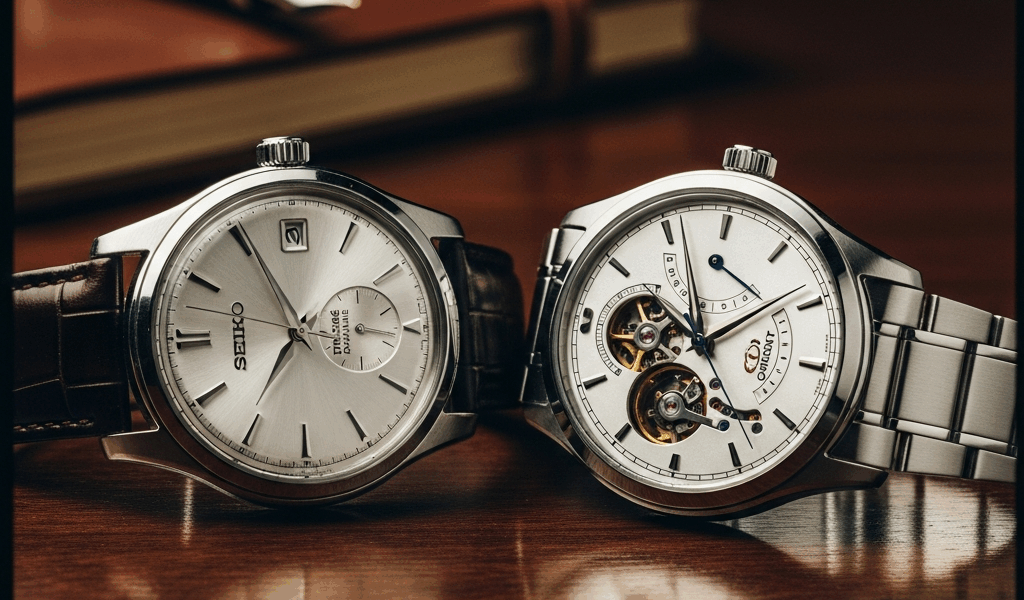
Seiko Presage Cocktail Time vs Orient Star Classic — Japanese Dress Watch Showdown
This debate has gotten complicated with all the forum noise and Discord arguments flying around. As someone who spent two genuinely obsessive weeks with both watches sitting in my cart — cursor hovering, one browser tab open for each product page — I learned everything there is to know about this particular decision. Zero clarity. Just mounting anxiety and a wedding anniversary deadline. This is the article I wish I’d had. Don’t make my mistake.
This article includes affiliate links. We may earn a commission at no extra cost to you.
Our Top Picks
This section includes affiliate links. We may earn a commission at no extra cost to you.
Seiko SRPB43 Presage Cocktail Time
Ice blue dial, automatic 4R35, 50m water resistant
$295.00
Check Price on AmazonTwo Japanese Dress Watch Philosophies
Pulled into this by a $400 budget and a calendar that wasn’t cooperating, I realized fast that these two watches aren’t actually competing on the same terms. On paper they look almost identical — Japanese automatics, sub-$600, beautiful dials, decades of real horological credibility behind each brand. But what is the actual difference? In essence, it’s two completely different ideas about what a dress watch should accomplish. But it’s much more than that.
The Seiko Presage Cocktail Time — the SRPB41 and its siblings in the SSA series — is built around dials Seiko describes as “cocktail-inspired.” The shimmer of liquid under bar light. Crushed ice iridescence. A sunset drink gradient. It sounds like marketing copy. It genuinely isn’t. See one in person and the concept clicks immediately — there’s nothing else at this price that looks like it.
The Orient Star Classic — models like the RE-AV0003S or the open-heart RE-ND0005L family — goes somewhere else entirely. Orient Star is Orient’s premium sub-brand, sitting above the standard lineup, and the Classic collection leans hard into traditional horological signaling. Power reserve indicators. Skeletonized bridges. Sapphire crystals. The message is quiet but legible: this watch knows what it’s doing.
Aesthetic artistry versus horological competence. That’s the real fork in the road here. That’s what makes both options endearing to us dress watch obsessives — neither is wrong, they’re just answering different questions.
Dial Quality — Where Presage Shines
Probably should have opened with this section, honestly. For a certain kind of buyer, nothing else matters until the dial conversation is settled.
Before I handled a Presage Cocktail Time in person, I thought the dial hype was embarrassingly overblown. I was wrong. Genuinely, specifically wrong in a way I didn’t expect.
The SRPB41 “Star Bar” dial — deep blue and silver sunburst, shifting from near-black at the edges to an icy silver-blue at the center — is not something any photograph captures accurately. It has a multi-layered lacquer texture that changes character with every degree of wrist rotation. Under fluorescent office lighting it reads almost conservatively dark. Under candlelight it opens up into something luminous — genuinely luminous, not just shiny. That’s Seiko’s Shizukuishi craftsmanship facility doing exactly what it was built to do.
Specific details worth knowing on the Cocktail Time dials:
- Applied indices polished on multiple faces — they catch light from angles where the dial itself stays completely dark
- The SRPB43 “Silk Road” champagne variant transitions through four distinct tonal zones across the gradient
- The sunburst texture has a physical grain — run a fingertip across the crystal and you can feel the direction of it
- Hands are faceted and polished, not printed flat — the beveling is visible under magnification
The Orient Star Classic dials are genuinely good. The guilloché-style decoration on the RE-AV0003S is a real machined pattern, not printed. The power reserve subdial at 12 o’clock is clean and legible. But compared to the Presage, the Orient Star dials are doing something different — they’re signaling competence rather than chasing beauty. The Presage dials are unambiguously trying to be beautiful. At $350–$450, they succeed more completely than anything else in the category.
One place Orient Star pushes back hard — the open-heart variants. The RE-ND0005L shows the balance wheel through a cutout at 9 o’clock. Compelling in a way that’s hard to argue with. If movement display matters to you, that changes the entire dial conversation.
Movement and Accuracy — Orient Star Pulls Ahead on Paper
The Seiko Presage Cocktail Time runs on the 4R35 caliber — 24 jewels, hand-winding, hacking, 21,600 vph, rated at -15/+45 seconds per day. That tolerance is wide. In real use, a properly regulated 4R35 usually lands around +10 to +15 seconds daily, which is acceptable without being impressive. Power reserve is 41 hours. No indicator on the dial to tell you where you stand.
The Orient Star Classic uses the F6B22 caliber. Here’s where things get interesting:
- 26 jewels
- 21,600 vph beat rate
- Rated accuracy of -10 to +30 seconds per day — meaningfully tighter
- 50-hour power reserve
- Power reserve indicator displayed at 12 o’clock on the dial
- Hand-winding and hacking both included
Orient Star wins on specs. The 50-hour reserve versus 41 hours is a practical difference — take the watch off Friday evening, it’ll probably still be running Monday morning. The accuracy rating is tighter. And the power reserve indicator earns its place — it’s genuinely useful information, not complication theater.
Where Presage recovers ground: movement finishing. The 4R35, particularly in higher-spec SSA references, shows more deliberate decorative work than the F6B22. The rotor is more elegantly shaped. The bridges visible through the caseback have better anglage. If you flip the watch over regularly, the Presage often looks more considered.
Net result — Orient Star for daily performance. Presage for caseback aesthetics. Your priorities make the call.
On the Wrist — Size, Weight, Comfort
Case dimensions matter more for dress watches than almost any other category. A dress watch lives under a shirt cuff. It has to disappear when you need it to.
The Presage Cocktail Time SRPB41 runs 40.5mm diameter, 12.5mm thick, roughly 47mm lug-to-lug. Stainless steel case, brushed and polished finishing mixed together. Ships on a bracelet or leather strap depending on reference — the bracelet is acceptable but most buyers swap it for leather within a few months anyway, which honestly suits the watch better.
The Orient Star Classic RE-AV0003S is 40.8mm diameter but sits noticeably thinner at 11.4mm. Lug-to-lug approximately 46.5mm. That thinner profile is genuinely significant under a dress shirt cuff — the Orient Star slides under a French cuff more cleanly, lies flatter against the wrist, disappears more completely. For formal occasions — which is presumably why either of these is on your radar — that slimmer profile is a real, practical advantage.
Both watches run 20mm lug width. Your existing strap collection works with either. That’s convenient and probably worth knowing before you commit.
One practical note — most Presage Cocktail Time references use Seiko’s hardlex crystal, not sapphire. The Orient Star Classic uses sapphire. For a dress watch that occasionally brushes against a doorframe or desk edge, sapphire is more forgiving. Hardlex scratches from normal wear. Sapphire doesn’t, unless you’re actively trying.
The Verdict — Which Japanese Dress Watch Wins
Here’s the honest answer. It’s slightly messier than a clean knockout.
Buy the Seiko Presage Cocktail Time if the dial is what you’re actually buying the watch for. For a lot of people, it should be. Nothing from Tissot, nothing from Hamilton, nothing in the standard Orient lineup produces that specific quality of visual drama at $350–$450. The SRPB41’s midnight blue with silver sunburst — apparently just a production watch, technically, and yet it stops people cold. If you want strangers to glance at your wrist and ask what you’re wearing, the Presage delivers that every time.
Buy the Orient Star Classic if you want more technical watch for the money. Sapphire crystal, 50-hour power reserve, tighter accuracy, thinner case profile — these add up to something more practically refined. The power reserve indicator is a real complication, not decoration. Sitting slimmer under a cuff matters at a black-tie event. And the open-heart variants give you a movement view no Cocktail Time reference can touch.
If I had to pick one — and I did, eventually, standing in front of my laptop at 11pm on a Tuesday — I went with the Orient Star Classic RE-AV0003S. The sapphire crystal decided it for me. I’d scratched a hardlex crystal on a previous watch through nothing dramatic, just normal daily wear, and I wasn’t doing that again on a dress piece. The thinner profile sealed it. But I still miss looking at Cocktail Time dials. Frustrated by my own practicality, I occasionally pull up the SRPB41 product page just to look at it. That blue is something else.
The one-line version: Orient Star Classic is the better watch. Seiko Presage Cocktail Time is the more beautiful watch. Both are true simultaneously — which one matters more is a question only you can answer.
Either way, you’re getting something genuinely special from Japanese watchmaking. That part you can’t get wrong.


Stay in the loop
Get the latest ichronos updates delivered to your inbox.