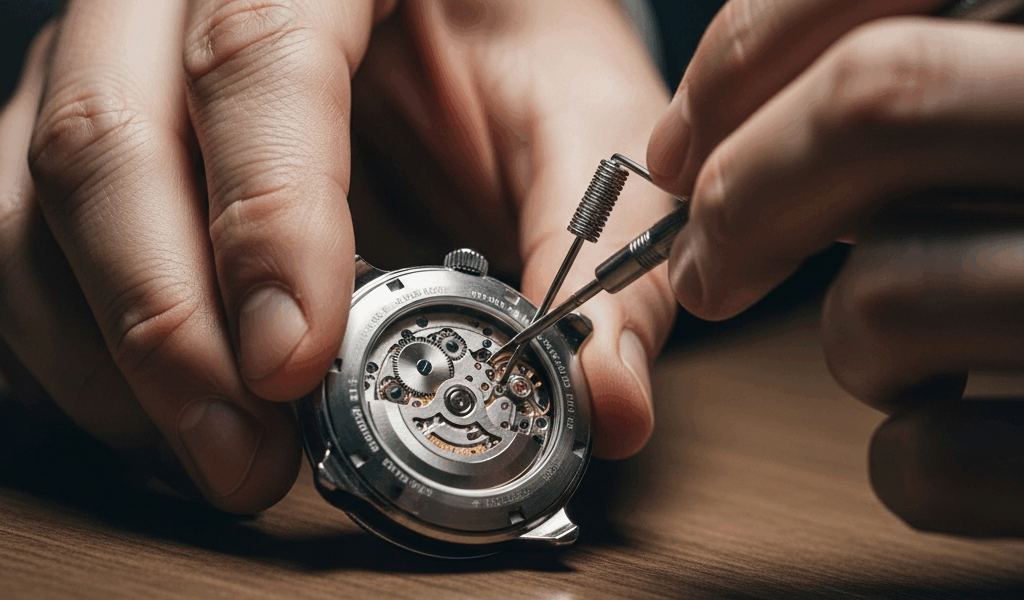
Automatic Watch Stops Overnight — Here Is Why and How to Fix It
Automatic watches have gotten complicated with all the conflicting advice flying around. And honestly, most of it overcomplicates what is — at its core — a pretty simple mechanical problem. As someone who spent an embarrassing stretch of time convinced my watch was broken, defective, or somehow cursed, I learned everything there is to know about why automatic movements die overnight. Turns out the fix was sitting right there on the nightstand the whole time. Forty turns of the crown. Thirty seconds. Done.
This article includes affiliate links. We may earn a commission at no extra cost to you.
But I’m getting ahead of myself. Let me back up.
It was a Tuesday. Late for a meeting. Glanced at my watch on the commute — 8:47am, according to the dial. Felt something was off. Checked my phone. 9:15am. The seconds hand wasn’t moving. Hadn’t been moving, apparently, since sometime around 4am. That specific cold frustration of a mechanical watch you genuinely love just quietly giving up on you — that’s what sent me down the rabbit hole.
Why Your Automatic Watch Stops Overnight
Here’s what most people don’t realize going in: automatic watches run on stored mechanical energy. A coiled spring inside the movement — called the mainspring — holds that energy. When the spring unwinds completely, the watch stops. Not gradually. Not reluctantly. It just stops.
That stored capacity has a name: power reserve. And it varies by movement. The Seiko NH35 — found in the 5 Sports line and about a hundred different microbrands — gives you 41 hours. Same with the 4R35. Miyota’s 8215, which Orient uses constantly and homage brands love, offers roughly 42 hours. The ETA 2824-2, a benchmark Swiss movement if there ever was one, lands somewhere between 38 and 42 hours depending on the variant.
Now do the actual math. Say you pull your watch off at 8pm. You had a desk day — sitting at a monitor, barely moving your arms, maybe a walk to the kitchen twice. Automatic movements charge themselves through wrist movement, specifically through a weighted rotor that spins when your arm swings. A sedentary day means the mainspring was never fully wound to begin with. Maybe you had 20 hours of reserve left when the watch hit the dresser. Twenty hours from 8pm gets you to 4am. You wake up at 7 and find a watch that’s been dead for three hours.
That’s it. That’s the whole mystery — low activity plus partial charge equals a stopped watch before morning. Not a defect. Not a mechanical failure. Just physics doing what physics does.
Temperature and humidity play a minor role, sure. But honestly? Nine times out of ten this is a power reserve issue, and a completely fixable one at that.
The 30-Second Fix Before Bed
Probably should have opened with this section, honestly.
Frustrated by dead mornings one too many times, I started manually winding my watch every night before setting it down — crown out, 30 to 40 turns clockwise, crown back in, done. The problem vanished immediately. Haven’t woken up to a stopped watch since I made it a habit. It takes less time than brushing your teeth.
The technique does matter slightly depending on what’s on your wrist.
If Your Crown Screws Down
Seiko dive watches and most water-resistant microbrands use a screw-down crown. You can’t wind through it until you unscrew it first — counterclockwise, like loosening a bottle cap — until it pops out to the neutral position closest to the case. That’s position one. Don’t pull it further unless you actually want to set the time.
How Many Turns
Thirty to forty turns, clockwise, smooth and steady. You don’t need to count religiously — just do it while your phone charges or the TV runs in the background. You’ll feel light resistance as the mainspring loads. As you approach full wind, that resistance shifts subtly — a little stiffer, a little different in character. Stop there. Forcing past a fully wound mainspring on movements without a slipping clutch creates unnecessary wear over time.
For the NH35 and 4R35, 30 to 40 turns from a partial charge tops you off. The Miyota 8215 behaves similarly. The ETA 2824-2 has a noticeably smooth winding feel and gets distinctly stiffer when fully charged — usually around 30 to 35 turns if you’ve been wearing the watch all day.
What This Actually Accomplishes
Starting the night with a full mainspring means the watch has a full tank when it goes still. An NH35 wound to capacity at 10pm will run until roughly 3am two nights later. Even a low-activity day tomorrow won’t eat through that buffer completely. You’ll still have enough reserve to survive the following night without touching the crown again.
This fix covers probably 80% of people reading this. It costs nothing and takes half a minute. Don’t make my mistake of assuming something was broken when the answer was this straightforward.
Is It Magnetization Instead
But what is magnetization, in this context? In essence, it’s when the fine metal components inside your movement pick up a magnetic charge from everyday objects — laptop speakers, magnetic bag clasps, the charging cable sitting six inches from where your watch sleeps every night. But it’s much more than a nuisance. A magnetized balance wheel oscillates inconsistently, and the watch runs fast in ways that winding will never fix.
Here’s the key distinction: stopping overnight points to power reserve. Running several minutes fast per day without stopping points to magnetization. Different problem entirely.
The Quick Compass Test
No special equipment needed. Open the compass app on your phone — the one that came pre-installed and has probably never been used. Hold your watch close to it. If the needle deflects noticeably when the watch comes near, you’ve got a magnetic charge. Simple as that.
Demagnetizing is fast and usually inexpensive — takes about three seconds with the right tool at most watch service centers. Don’t let anyone charge you significantly for it. I covered the full process, the causes, and prevention in a separate article — check the magnetized watch guide here — because it genuinely deserves its own dedicated treatment.
When Your Watch Needs Service
Here’s where I want to be straight with you, because I’ve watched people throw money at services they didn’t need and I’ve watched people delay services until they caused real damage.
If you’re winding to 40 turns every night and the watch is still dying within hours — not days, hours — and the movement is three to five years old or more, there’s a real possibility the oils inside have dried out. Lubricants in a mechanical movement don’t last forever. When they go, friction increases, energy transfer from the mainspring to the escapement becomes inefficient, and run time drops noticeably. Seiko recommends servicing every three years for heavy-use pieces. Swiss manufacturers typically say three to five. In practice, many people go longer without incident — but there’s a real ceiling.
Signs That Point to Service
- Manual winding to 40 turns gives you less than 20 hours of run time on a movement rated for 40-plus
- Significant timekeeping loss per day even after demagnetization
- Roughness or grinding sensation when winding — any texture that wasn’t there before
- The watch has been dropped or submerged beyond its rated water resistance
- You genuinely can’t remember the last service and you’ve owned it for five or more years
What Service Actually Costs
For a Japanese movement like the NH35 or 4R35, expect $60 to $120 USD at an independent watchmaker. Swiss movements — ETA 2824 territory — typically run $150 to $250 depending on your market. Seiko USA’s own service center charges around $100 to $130 for a Seiko 5 Sports, as of recent pricing. Official service centers and brand-name shops sit at the higher end. Independent watchmakers who actually specialize in mechanical movements — not battery swaps — are usually the better value.
Don’t make my mistake of assuming any jeweler handles mechanical movements. The person at the mall kiosk replacing quartz batteries is not the person you want inside your automatic. Ask directly whether they work on mechanical and automatic movements and which calibers they’re comfortable with. A competent watchmaker answers that question without hesitating.
Watch Winders — Worth It or Not
That’s what makes watch winders endearing to us collectors — they feel like proper accessories, purposeful and satisfying. But the honest answer about whether you need one is more boring than the marketing suggests.
Watch winders keep the mainspring topped off by slowly rotating the watch, mimicking wrist movement. If you own four watches and rotate through them — wearing a different one each day — a quality winder makes genuine sense. Coming back to a watch after three days off the wrist and finding it already set and running is legitimately convenient. That’s the use case they were built for.
If you wear one watch consistently, your wrist handles the job. The crown-winding habit before bed covers the gap on slow days. Spending $40 to $400 on a winder for a single daily wearer is an indulgence — not a solution.
Now — the thing nobody mentions about cheap winders: they can cause real problems. A low-quality unit set to the wrong rotation direction or the wrong turns-per-day setting stresses the rotor and winding mechanism. The NH35 and Miyota 8215 both use bidirectional winding rotors — they wind on both clockwise and counterclockwise rotation. Some Swiss movements are unidirectional. Wrong direction on a unidirectional rotor means the rotor spins freely while nothing winds — just wearing parts for no reason.
The Miyota 8215 is generally comfortable at 650 to 800 turns per day. The NH35 is similar. If you do buy a winder, buy one with adjustable TPD settings and switchable rotation direction. Brands like Wolf, Orbita, and Barrington make solid units. The $25 fixed-setting options on Amazon are the ones that generate watchmaker visits.
My actual recommendation — wind the crown before bed, get the winder only if you’re rotating a real collection. That’s the whole answer.
The Decision Tree — Where Does Your Problem Land
Before spending any money or assuming something is broken, run through this quickly.
- Watch stops overnight after a low-activity day — Wind 30 to 40 turns before bed every night for a week. The problem almost certainly disappears.
- Watch gains several minutes per day but doesn’t stop — Do the compass test. Needle deflects? Magnetization. Go read the dedicated article on this site.
- Manual winding at 40 turns still gives less than 20 hours of run time — Check when the movement was last serviced. Three or more years of regular wear? Budget for a service.
- Brand new watch already stopping frequently — Contact the seller or manufacturer. A new movement failing early is a defect, not a maintenance problem.
Mechanical watches aren’t complicated once you understand what they actually need — wrist time, the occasional manual wind, distance from strong magnetic fields, and a service every few years. The overnight stopping problem that frustrated me for longer than I’d like to admit had a fix so simple it felt almost embarrassing. Forty turns of the crown. Set it down. Wake up to a running watch. I hope it’s that simple for you too.


Stay in the loop
Get the latest ichronos updates delivered to your inbox.