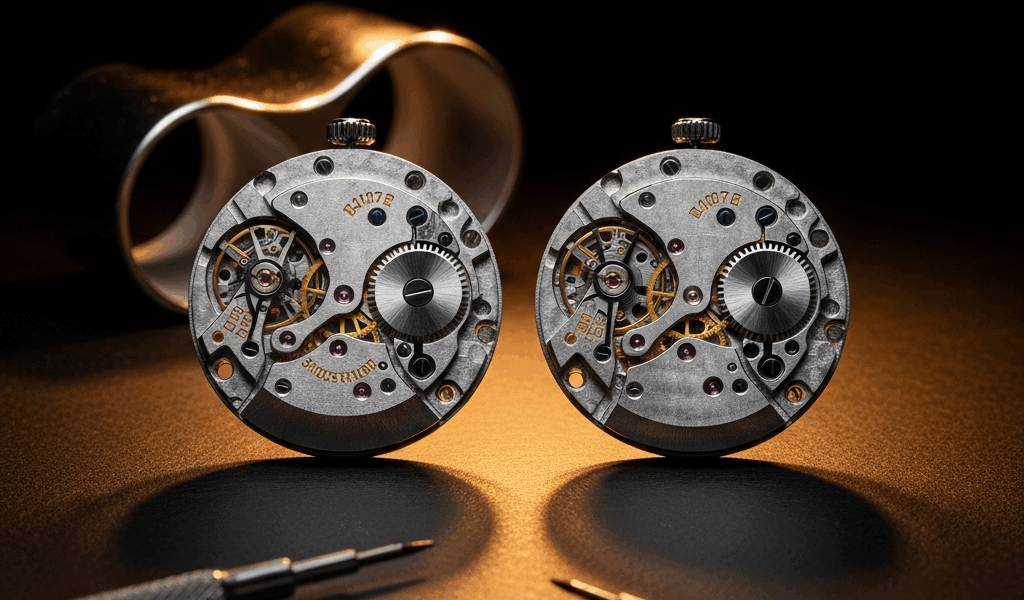
What You Actually Need to Know About Both Movements
The Miyota 9015 vs NH35 debate has gotten complicated with all the spec tables and shoulder-shrugging flying around. As someone who has worn both movements for years, pulled them apart on a workbench, and paid a watchmaker to fix what I broke, I learned everything there is to know about what actually separates these two. Today, I will share it all with you.
Both are automatic movements in roughly the same price tier. Both power hundreds of watches — everything from microbrands you’ve never heard of to mid-range Japanese manufacturers you absolutely have. The similarities end faster than most reviews want to admit.
| Specification | Miyota 9015 | Seiko NH35 |
|---|---|---|
| Beat Rate | 28,800 bph (8 Hz) | 21,600 bph (6 Hz) |
| Power Reserve | 42 hours | 41 hours |
| Hacking | Yes | Yes |
| Hand Winding | Yes | Yes |
| Movement Height | 3.9mm | 5.3mm |
| Jewels | 24 | 24 |
| Typical Retail in Movement | $30–$60 depending on source | $20–$45 depending on source |
That 1.4mm thickness gap — 3.9mm versus 5.3mm — is the number that jumps out every single time. Doesn’t sound like much. Then you try fitting a movement into a slim dress watch case and suddenly that 1.4mm is the whole conversation. The 9015 wins that fight, no argument needed.
Accuracy and Timekeeping in Daily Wear
Higher beat rate does translate to real-world smoothness. The 9015 at 28,800 bph produces a seconds hand that genuinely glides — not floats, but noticeably cleaner than the more mechanical tick you get from the NH35 running at 21,600 bph. Watch a lower-beat movement under magnification once and you’ll never unsee the difference. On the wrist it’s subtler. But it’s there.
More beats per hour means smaller positional errors go uncorrected for shorter windows of time. That’s what makes the 9015 slightly more accurate in practice — not dramatically, not chronometer-level, but consistently at the margins. We’re not comparing a precision instrument to junk here. Both are budget-tier automatics doing budget-tier automatic things.
Regulated 9015s typically run between -5 and +10 seconds per day based on what collectors report. Regulated NH35 movements usually fall in the -10 to +15 range, depending on the individual movement and how aggressively a watchmaker adjusted it. Unregulated out of the box, both are messier. I had one NH35-powered microbrand watch arrive at +22 seconds per day straight out of the packaging. Forty dollars at a local watchmaker brought it to +4. Worth doing with either movement, honestly — don’t make my mistake and just live with it.
Neither movement is COSC-certified. Neither is trying to be. Anyone claiming these movements compete with an ETA 2824 or Sellita SW200 on precision is stretching the truth hard. They compete on price-to-reliability, and on that front, they both beat most of the market.
Rotor Noise, Winding Feel, and Wrist Presence
Probably should have opened with this section, honestly — because for a lot of buyers, this is the dealbreaker question before anything else gets considered.
The Miyota 9015 rotor noise issue is real. Documented, widely discussed, and not something you should wave away as “not a big deal.” In a quiet room, sitting at a desk, rotating your wrist — you hear a scratchy, sometimes hollow sound. It’s a byproduct of the bearing design and rotor mass. Doesn’t indicate damage. Still bothers people. It bothered me.
The NH35 rotor runs quieter. Not silent — no automatic movement is — but lower-pitched, less intrusive. It has a softer presence on the wrist. Hand winding feel on the NH35 is slightly grittier than the 9015, but not unpleasantly so. Both hand wind adequately, which already puts them ahead of movements that technically offer hand winding but feel like you’re stripping a bolt every time you try.
The fix for 9015 rotor noise is an aftermarket rotor swap. DLW Watches and several other suppliers sell replacement rotors — Seagull-style skeleton rotors, solid alternatives — that reduce or eliminate the sound entirely. Budget $20–$50 for the rotor itself, plus installation time if you’re not doing it yourself. It solves the problem. It also adds cost the NH35 never creates in the first place.
Where the 9015’s slim profile earns real praise is wrist presence. Watches built around it can achieve finished case heights below 10mm. That’s dress-watch territory. NH35-based builds run thicker by design — perfectly appropriate for sport or tool watches — but that limits design flexibility in ways that matter if slim is the goal.
Which Movement Is Easier to Service and Mod
Sourced directly from a conversation with a watchmaker in Chicago who services both regularly: the NH35 is simpler to work on, cheaper to source parts for, and better documented at every skill level from complete beginner to seasoned professional.
The NH35 parts ecosystem is enormous. Stems, dials, hands, rotors, mainsprings, click springs — all widely stocked at suppliers like Cas-Ker and Jules Borel, plus dozens of direct import sources shipping out of Japan. Tutorial support on WatchUSeek and YouTube covers every common failure mode in detail. I learned to replace an NH35 crown and stem by watching one 22-minute YouTube video and practicing on a $15 movement I bought specifically to destroy. That was 2021. It worked on the first real attempt.
The Miyota 9015 is respected by professional watchmakers for build quality and reliability — fewer parts break in the first place. But when something does break, you’re operating in a smaller parts ecosystem. Replacement parts exist, distributed through authorized Miyota channels, but DIY resources are thinner, community support is smaller, and individual components cost slightly more when sourced in small quantities.
Service intervals for both movements land around 3–5 years under normal use. NH35 service at a U.S. watchmaker typically runs $75–$120 depending on rates and what needs replacing. The 9015 runs slightly higher — $100–$150 is common — partly because fewer watchmakers have worked high volumes of them and partly because parts sourcing adds time. Not a crushing difference. A real one over a decade of ownership.
For modders building custom watches, NH35 wins this category outright. Dial and hand compatibility, the swap community, the tutorial ecosystem — nothing touches it at this price point. The 9015 is a fine movement to spec into a build. But if you’re planning to swap parts, experiment, and learn by doing, NH35 might be the best option, as watch modding at this level requires accessible documentation and cheap replacement parts. That is because mistakes happen constantly at the beginning, and an NH35 lets you make them without much financial consequence.
Miyota 9015 or NH35 — Which Should You Pick
Here’s the answer without hedging.
Pick the Miyota 9015 if you want a thinner case profile, a visibly smoother seconds sweep, and you’re buying a finished watch where servicing is someone else’s problem. The 9015 is the right movement for dress watches, slim builds, and buyers who prioritize wrist aesthetics over tinkering. The rotor noise might bother you — budget $20–$50 for an aftermarket rotor swap and move on. That’s what makes the 9015 endearing to us slim-watch people, honestly. It does things no NH35 build can match in that form factor.
Pick the NH35 if you’re a modder, a DIY service learner, or someone planning to own a watch for ten-plus years who wants the cheapest possible long-term service path. The NH35 ecosystem is the closest thing affordable watchmaking has to a universal standard. Parts are cheap. Help is everywhere. Watchmakers know it cold. I’m apparently a chronic tinkerer and the NH35 works for me in ways the 9015 never quite did — at least not without extra investment.
Frustrated by articles that call it a tie when the use cases clearly diverge, I’ve tried to be direct here. So, without further ado, let’s be blunt: neither movement is universally better. But for your specific situation, one of them is clearly the right call. Make it.

Stay in the loop
Get the latest ichronos updates delivered to your inbox.