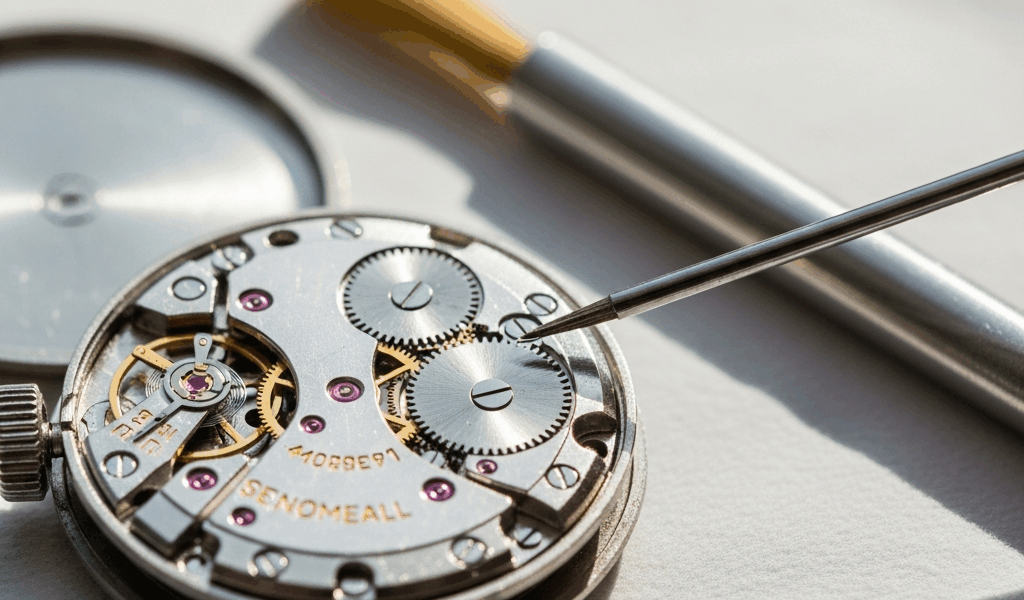
Why the 8215 Keeps Stopping — The Short List
Miyota 8215 troubleshooting has gotten complicated with all the forum noise flying around. Half the threads tell you to rush it to a watchmaker. The other half insist it’s magnetized. As someone who owns four watches running this exact caliber, I learned everything there is to know about why the 8215 stops. Today, I will share it all with you.
Here’s the actual short list: insufficient manual winding, a worn rotor, magnetization, or real internal failure — in roughly that order of likelihood. The first three you can diagnose yourself, at home, with no tools. So, without further ado, let’s dive in.
Step 1 — Manual Wind It First
The 8215 is an automatic. People hear that and assume “never needs winding.” Wrong. This caliber needs aggressive manual winding — at least if you want a reliable baseline for diagnosing anything else.
No hacking seconds. Winds stiffer than a Seiko 7S26. Noticeably stiffer than an ETA 2824. You’re looking at 20 to 30 full crown rotations to properly charge the mainspring. Not gentle nudges. Full rotations, stop to stop, with real intention.
Here’s what you’re looking for:
- Normal resistance: The crown turns with real tension — smooth, but you feel it working. A faint detent every few turns. Think mechanical pencil, not butter knife. That’s your baseline.
- Slipping crown: Spins freely. No detent. No resistance halfway through a turn. That’s a stripped stem or crown issue — separate problem entirely, but it needs attention before anything else.
After 25 turns, set the watch flat on a table. Second hand moving? Good. That rules out mainspring failure immediately. That was the easy part.
Warning: Non-screw-down crown owners — double check your crown position. Pull out one click for hand-setting, two for time. Wind only when the crown is fully seated. I’ve accidentally set dates for five minutes thinking I was winding. Don’t make my mistake.
Now wear it actively for a couple hours. If it keeps running, winding was the whole problem. You own an affordable automatic that occasionally wants a little manual help. Completely normal. Problem solved.
Step 2 — Check the Rotor for Slippage
Frustrated by a watch that stopped again twenty minutes after winding, most owners immediately assume something catastrophic broke inside. It usually hasn’t. A worn rotor is far more common than a failed movement — and it has a very specific tell once you know what to look for.
The rotor sits on a bearing. That bearing wears. The slip-spring loses tension. The rotor starts spinning freely without actually transferring energy to the mainspring. The watch runs beautifully for two hours after a good hand-wind, then dies. Every time. That pattern is the giveaway.
The wrist test is simple. Manually wind the 8215 — 20-plus turns. Then wear it actively for 30 minutes. Swing your arm. Walk around. Live your life. Track what happens:
- Keeps running, maybe gains a few seconds? Rotor is doing its job fine.
- Stops within 30 minutes of active wear? Rotor is almost certainly slipping. It wound the mainspring initially, but it’s not recharging it as you move.
Probably should have opened with this section, honestly. Rotor slippage is the second most common culprit with the 8215, and diagnosing it yourself saves you a frustrating guessing game at the watchmaker’s counter.
What does fixing it cost? A rotor replacement or slip-spring re-tensioning — both watchmaker jobs. Parts for the 8215 run under $10. Labor ranges from $30 to $80 depending on your city and the shop. Annoying but manageable. At least you walk in knowing exactly what you’re paying for.
Step 3 — Test for Magnetization
But what is magnetization doing to your watch? In essence, it’s magnetic interference warping the behavior of the hairspring or balance wheel. But it’s much more than that — it’s invisible, weirdly common, and routinely mistaken for movement failure.
I’m apparently sensitive to this issue and have personally watched three people with the 8215 convince themselves they needed full service when the real culprit was a phone case or a countertop speaker. The watch runs for a few minutes, freezes, runs again, freezes. Maddening pattern.
The home test takes 30 seconds:
Open your phone’s compass app. Hold the watch roughly 2 inches from the screen. Watch the needle. Sharp deflection toward the watch? Movement is magnetized. The bigger the deflection, the worse it is.
Not a perfect diagnostic — more like a strong indicator. But it’s good enough to bring to a watchmaker with confidence. Demagnetization typically runs $15 to $40 and takes about 10 minutes on proper equipment. Some shops do it free if you’re already bringing something in for service.
Common culprits: sleeping with the watch on your nightstand next to your phone, setting it on a Bluetooth speaker, resting it near a tablet with a magnetic case. The 8215 has zero magnetic shielding. None. It’s an open target at $80 retail.
When to Actually Take It to a Watchmaker
If you’ve worked through all three steps above and nothing resolved it — the winding felt wrong, the rotor test failed, and the compass went wild — you’ve officially ruled out everything user-serviceable. That’s what makes this diagnostic flow endearing to us watch nerds: it tells you exactly when to stop guessing.
At that point you’re likely looking at mainspring failure, a broken gear train, or pallet fork damage. Here’s what service realistically costs:
- Full service with parts: $60 to $120 depending on location and what’s actually broken.
- Parts alone: $5 to $25 for a mainspring, pallet assembly, or gear train components.
- Labor: $40 to $100 depending on your city and the shop’s reputation.
Be honest about the math. Watch cost $40 new? Full service at $100 doesn’t pencil out. Replace it — the 8215 is literally available as a replacement movement for around $25. Watch cost $150 and labor is $50? Service makes complete sense.
When you call the watchmaker, lead with what you’ve already ruled out. “I’ve manually wound it, ran the wrist test for rotor slippage, and checked for magnetization with a compass app.” That single sentence speeds up diagnosis and occasionally saves you a consultation charge. Watchmakers appreciate customers who’ve done real homework.
One last thing worth saying plainly: most 8215 movements that “stop working” never make it to a watchmaker’s bench. The owner simply never wound them. It’s an automatic — yes — but automatics still need occasional hand-winding if you’re not wearing them daily or if your wrist movement is low. Check your winding habit first. Then the rotor. Then magnetism. By the time you’ve gone through all three, you’ll know exactly what’s wrong and exactly what to do about it.


Stay in the loop
Get the latest ichronos updates delivered to your inbox.