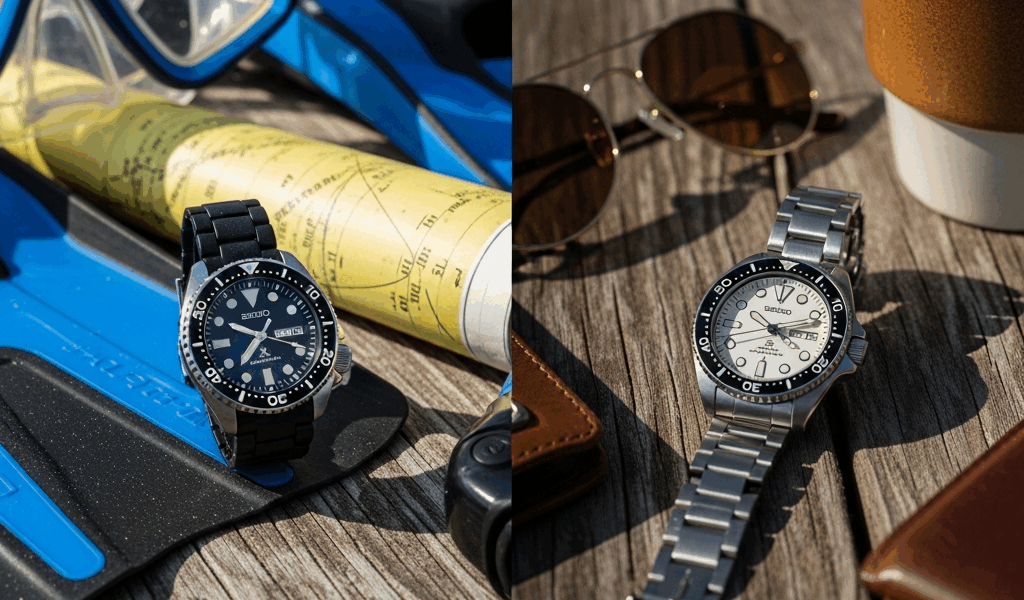
Seiko Prospex vs Seiko 5 Sports — Which Is Worth It
The Seiko Prospex vs Seiko 5 Sports debate has gotten complicated with all the forum noise and conflicting opinions flying around. As someone who spent three weeks convincing myself the price gap meant the Prospex was categorically better, I learned everything there is to know about this particular rabbit hole the hard way. Someone on a watch forum eventually pointed out both lines often run the identical NH35 movement. That stopped me cold. Today, I will share it all with you — so you don’t walk into the same confusion headfirst.
What You Actually Get With Each Line
Seiko Prospex is a tool-watch line. But what is Prospex, exactly? In essence, it’s a compression of “Professional Specifications.” But it’s much more than that — Seiko leans hard into dive watches, field watches, and aviation references. The underlying idea is that someone, somewhere, might actually depend on one of these. That framing shapes how the watches are engineered even at the lower end of the catalog.
Seiko 5 Sports is different in intent. It launched as an accessible, everyday automatic — no-nonsense, priced for someone stepping off a quartz watch for the first time. The “5” designation historically stood for five standards: automatic winding, day-date display, water resistance, recessed crown, and a durable case. Today that framework is loose, but the accessible daily-wearer positioning holds.
Here’s what makes the comparison genuinely confusing. A lot of Prospex models in the $250–$450 range and Seiko 5 Sports models in the $150–$280 range use the same NH35 or NH36 automatic movement. Same engine. Different packaging, different price. Knowing that upfront changes everything about how you evaluate the gap between them.
Design and Build — Where They Actually Differ
The finishing is the first real difference you’ll notice in hand. Prospex cases — particularly the SRPE and SPB families — show more deliberate alternation between brushed and polished surfaces. Not Grand Seiko territory, but noticeably more intentional than the Seiko 5 Sports execution. That’s what makes the Prospex endearing to us tool-watch people who care about that stuff.
Case size variety skews larger in Prospex. 45mm divers are common. Seiko 5 Sports tends to stay in the 42–43.8mm range for most references, which actually fits more wrists without drama.
Crystal and Water Resistance
This is where a real decision point appears. Most Seiko 5 Sports models ship with Hardlex crystal — a mineral glass Seiko heat-treats for scratch resistance. It’s fine. Does its job. But entry Prospex models sometimes use Hardlex too, while mid-tier and upper SPB references step up to sapphire or Seiko’s own “Saplex” coating. Worth checking the specific reference before assuming anything.
Water resistance is a bigger gap, honestly. Seiko 5 Sports models are typically rated at 100m — usable for swimming, cautious snorkeling, but not serious diving. Many Prospex divers sit at 200m with ISO 6425 diver certification on certain models. That certification requires tested shock resistance, anti-magnetism standards, and luminance requirements that go well beyond the number stamped on the caseback.
Bracelet Complaints Are Real
The Seiko 5 Sports bracelet has a reputation. Hollow end links, noticeable side-to-side play, a clasp that feels budget even for the price point. Doesn’t ruin the watch, but it’s the first thing people notice when they pick one up after handling something more expensive. Prospex bracelets aren’t flawless either — but the oyster-style bracelets on something like the SRPE53 feel noticeably more substantial. Budget $30–$60 for an aftermarket rubber strap or a decent replacement bracelet from DLW or Strapcode if you go the Seiko 5 Sports route. Don’t make my mistake of living with the stock bracelet for six months before finally swapping it out.
Movement and Accuracy — Same Engine, Different Price
Probably should have opened with this section, honestly. It’s the core of why people feel confused comparing these two lines.
The NH35 and NH36 are workhorses. 24 jewels, 21,600 vph beat rate, hand-winding and hacking. Seiko specs them at +45/-35 seconds per day — a wide window. Real-world user reports from WatchUSeek and various Reddit threads put average accuracy closer to +10 to +20 seconds per day on a well-regulated example, though variation exists across individual pieces. I’m apparently one of the lucky ones and my NH35-equipped SRPD runs at around +8 seconds daily, while a friend’s identical reference never got below +22. That’s just the nature of mass-produced movements.
The Prospex line’s higher-end models use different movements entirely. The 6R35 appears in several SPB references and offers a 70-hour power reserve versus the NH35’s 41 hours, plus tighter factory regulation to +25/-15 seconds per day. Tangible upgrade. But if you’re comparing a Seiko 5 Sports SRPD to an entry-level Prospex SRPE running the same NH35, you’re not buying a better movement. You’re buying different case engineering, different finishing standards, and — in dive-specific models — an ISO certification that means engineers actually stress-tested the crown gasket.
The extra $100–$150 between comparable NH35-equipped models buys construction choices. Not horological advancement. Keep that framing in your head.
Who Should Buy Which One
So, without further ado, let’s dive in. Forget the brand prestige angle — that’s noise at this price range.
The Casual Daily Wearer on a Budget
Buy the Seiko 5 Sports. Full stop. The SRPD55, SRPD71, or the newer SRPE series give you a solid automatic under $200 street price, a wide variety of dial designs, and enough build quality to wear daily without anxiety. Swap the bracelet for a NATO or rubber strap and forget about it entirely.
Someone Who Actually Swims or Dives
Buy the Prospex. The 200m ISO-certified models — the SRPE27, the mid-range SRPD divers — give you tested water resistance with crown gasket construction built for actual submersion. Using a 100m Seiko 5 Sports for regular ocean swimming isn’t catastrophic, but you’re working against its design intent. The Prospex is built for that use. Use it accordingly.
The Display-Case Collector Wanting Variety
Seiko 5 Sports wins on sheer variety and cost per piece. The line releases colorways and collaborations constantly — the Street Fighter series, the Sports Style references in bold dials. You can build a diverse rotation for less outlay. If the watches are going in a case more than on a wrist, spend less per watch and buy more of them. Simple math.
Someone Upgrading From a Fashion Watch
Frustrated by plastic fashion pieces and craving something with real mechanical weight, this buyer wants a watch that feels like a genuine step up — not just technically but in hand. For that person, the entry Prospex is the right call. The finishing and the tool-watch context give the wear experience more substance, and the 200m rating means it survives real life without constant babying.
Price Gap — Is Prospex Worth the Premium
Street prices matter more than MSRP here. The Seiko 5 Sports SRPD family runs $150–$230 at authorized dealers and on Amazon. The Prospex SRPE line sits at $230–$350. The SPB series with 6R35 movements and sapphire crystals climbs to $450–$600.
The $80–$120 gap between comparable NH35 models is defensible if you want the diving certification or the superior finishing. It’s not defensible if you just want an automatic watch to wear to work. Pay the gap for function. Don’t pay it for the name.
The SPB tier at $450+ is a different conversation entirely. There you’re getting the 6R35 movement, sapphire crystal as standard, noticeably better lug finishing, and a watch that competes seriously with Tudor’s lower references and the Citizen Promaster line. That tier represents genuine value per dollar for someone spending $400 on a diver that will see actual water.
For everyone else — the budget-conscious, the casual wearer, the collector who wants shelf variety — the Seiko 5 Sports at its price point is one of the most honest value propositions in mechanical watches right now. I own two. Never regretted either purchase. The Prospex I added later serves a specific purpose. That’s the right way to approach both lines: as tools built for different situations, not as rungs on some prestige ladder.



Stay in the loop
Get the latest ichronos updates delivered to your inbox.