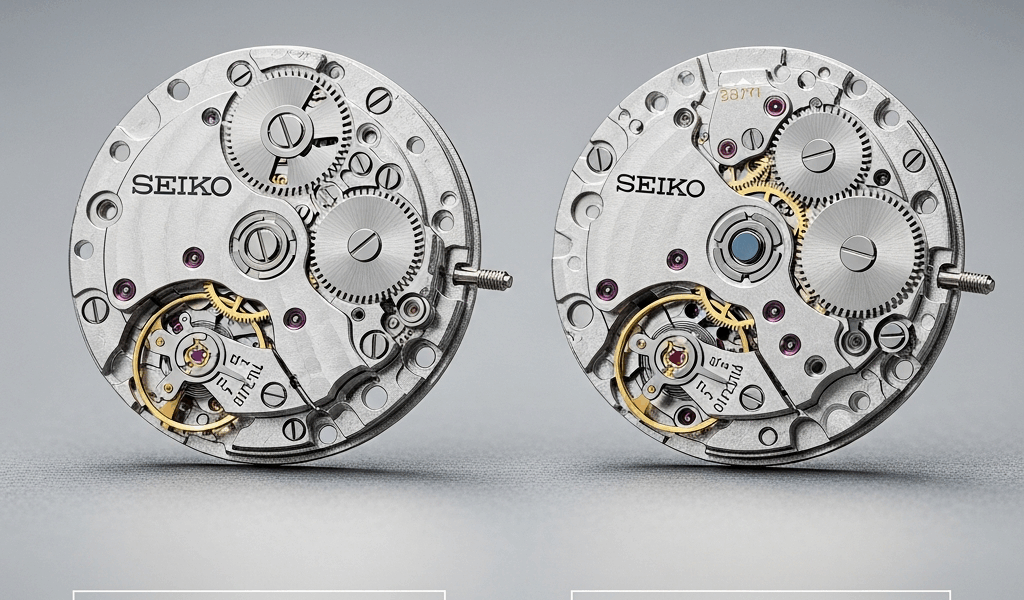
Seiko NH35 vs Miyota 8215 — Which Budget Movement Is Actually Better
The Seiko NH35 vs Miyota 8215 debate has gotten complicated with all the diplomatic fence-sitting flying around. Every comparison I’ve read bends over backward to avoid just picking a side. As someone who’s worn watches running both movements for years — bought them, modded them, regulated them, and in one genuinely embarrassing moment, dropped a bare movement onto a tile floor at 1am trying to swap a dial — I learned everything there is to know about what separates these two. So let’s skip the hedging.
This article includes affiliate links. We may earn a commission at no extra cost to you.
Short version: the NH35 is better for most buyers. Full stop. There’s one specific scenario where the 8215 makes sense, and I’ll get there. But don’t make my mistake of reading six wishy-washy comparisons before someone just told me the answer.
The 30-Second Answer
If you’re choosing between a watch powered by the Seiko NH35 and one running the Miyota 8215 — and everything else is roughly equal — buy the NH35. It hacks. It hand-winds. The 8215 does neither.
Probably should have opened with this section, honestly. Some reviews treat hacking and hand-winding like bonus features. Nice extras. They’re not. Hacking — stopping the seconds hand when you pull the crown — lets you set the time precisely. Hand-winding lets you top off the power reserve without strapping the watch to your wrist and doing the Macarena around your living room. These are baseline expectations for a mechanical watch in 2024. Leaving them out isn’t a budget compromise. It’s a design choice that benefits nobody wearing the watch.
The 8215 makes clear sense only when the specific watch you want already has it. Maybe it’s a San Martin piece with a dial that makes your heart do something weird. Maybe it’s a vintage-inspired design that fits your wrist like it was made for you. In that case, you’re not choosing the movement — you’re choosing the watch. That’s fine. The 8215 isn’t broken. It just loses on features when compared head-to-head.
Head-to-Head Specs Comparison
Numbers first — subjective stuff after. Both movements power a huge range of affordable watches from Seiko’s own 5 Sports lineup, Orient, San Martin, Steeldive, and a long tail of microbrands you’ve probably fallen down a rabbit hole reading about at midnight.
| Specification | Seiko NH35 | Miyota 8215 |
|---|---|---|
| Diameter | 28.4mm | 28.4mm |
| Thickness | 5.78mm | 5.45mm |
| Beat Rate | 21,600 bph | 21,600 bph |
| Power Reserve | 41 hours | 42 hours |
| Hacking | Yes | No |
| Hand-Winding | Yes | No |
| Accuracy (factory spec) | +45/-35 sec/day | +/-15 sec/day |
| Date Complication | Yes | Yes |
| Jewels | 24 | 21 |
That Miyota accuracy spec is going to look tempting. Plus or minus 15 seconds per day versus the NH35’s factory rating of +45/-35. Don’t get too excited — real-world results tell a different story, and I’ll get into that next.
Power reserve is a non-issue. One hour across nearly two full days of running time. The thickness gap is minor but real — the 8215 sits slightly flatter at 5.45mm versus 5.78mm, which matters more to the engineers designing the case than it ever will to you wearing it.
Real-World Accuracy After 6 Months
That accuracy spec discrepancy in the table is honestly one of the most misleading things about this whole comparison. Factory specs describe the acceptable range of deviation when a movement ships. They’re not performance guarantees — they’re quality control thresholds.
In practice, across forum reports, community tests, and my own time with four NH35-powered watches and two 8215 watches, both movements tend to run somewhere between +5 and +15 seconds fast per day under normal wearing conditions. The Miyota’s better spec doesn’t translate to meaningfully better real-world timekeeping.
What actually matters is what you can do about it. The NH35 has an accessible regulator — reachable by a watchmaker, or by you with the right tools and a reasonably steady hand. I had a Seiko SRPE55 running about +12 seconds per day. Spent roughly 20 minutes with a free phone timing app and a fine screwdriver from a $12 Amazon set and got it down to +3. That’s what makes the NH35 endearing to us hobbyists — it meets you where you are.
Frustrated by a brand-new Steeldive 8215-powered diver running +18 seconds per day, I looked into every possible fix and came up empty. You can technically send it to a watchmaker who might access the regulator internally, but that often costs more than the watch itself. With the NH35, I’ve regulated three separate movements using nothing but a free timing app called Timegrapher and that same cheap screwdriver set. Total investment: maybe $25 in tools and an afternoon of YouTube. The 8215’s better spec is theoretical. The NH35’s regulation access is practical.
The Noise Issue Nobody Warns You About
Most reviews skip this entirely. It’s the thing that surprised me most once I started paying close attention.
The Miyota 8215 rotor is loud. Not broken-loud — not anything alarming. But noticeably, persistently loud in quiet environments. At a desk. Reading in bed. Anywhere calm and still. The rotor spins on ball bearings and produces a distinct rattling whir that travels right through the case. Hold your wrist near your ear in a quiet room and you’ll hear it clearly.
The NH35 isn’t silent — no automatic movement is. But the rotor system runs meaningfully quieter, and most people stop noticing it entirely within a few days of wearing an NH35-powered watch.
I wore a San Martin SN015 — brushed case, sapphire crystal, genuinely handsome dial — running the Miyota 8215 for about three months. Loved almost everything about it. But during desk work, during calls, I kept glancing at my wrist wondering what the noise was before remembering it was the watch. Eventually switched to an NH35-movement version from a different brand for that same wrist slot. The noise difference is real and it accumulates.
This matters most for dress watches — quiet offices, dinner out, meetings. Those are exactly the environments where rotor noise surfaces. A dive watch you’re actually wearing while diving? You’ll never hear it. But anything with a dressed-up aesthetic deserves the quieter option. Some 8215 variants like the 8217 have slightly different rotor configurations, apparently, but the fundamental noise character stays consistent across the family. It’s a design trait, not a defect.
Which One to Pick for Your Mod Build
Pulled into the modding hobby by a YouTube rabbit hole in late 2021, I built my first watch using an NH35 movement, an aftermarket Turtle case, a lumed chapter ring, and a gradient blue dial from a seller in Shenzhen. The build took a weekend. The parts took three weeks to arrive. The movement cost me $35 from a reputable eBay seller — which felt insane until I realized what I was getting.
If you’re building a custom watch — sometimes called a Seiko mod or a Franken-watch — the NH35 is the clear choice. Not even close.
While you won’t need a professional watchmaker’s bench, you will need a handful of reliable parts sources, and the NH35 makes that dramatically easier. Here’s what that looks like practically:
- Hundreds of aftermarket dials are specifically designed around NH35 dimensions and dial foot placement
- Hands from dozens of suppliers are fitted and sold specifically for NH35 compatibility
- Cases — Bambino, Turtle, SKX007 homage designs, field watch clones — are largely sized around the NH35 footprint
- YouTube tutorials, forum threads, and troubleshooting guides exist in enormous volume for NH35 builds specifically
- Replacement parts like crowns, stems, and gaskets are cheap and consistently available
The Miyota 8215 modding ecosystem is a fraction of this. There are dials made for it. Cases that fit it. But when you hit a problem — and you will hit at least one per build — finding specific guidance for an 8215 build is genuinely harder. I once spent 45 minutes searching for a specific answer about a Miyota stem length and found three forum posts from 2014 and a dead link to a French watchmaking site. The same question about an NH35 returns ten active threads and a pinned community guide. That community infrastructure is as real a feature as any number in the spec table.
What About the Miyota 9015
But what is the 9015? In essence, it’s a higher-spec Miyota movement with hacking, hand-winding, and a faster 28,800 bph beat rate. But it’s much more than that — it’s essentially the version of Miyota’s lineup that competes legitimately with Swiss movements at the entry level. It shows up in microbrands in the $300–$500 range. If you’re considering Miyota generally and your budget stretches that far, it’s worth knowing about. The 8215 isn’t the only option Miyota makes — just the most common one at the entry level, and the one that gets compared to the NH35 most often.
The Verdict
The Seiko NH35 wins this comparison for most buyers. Hacking and hand-winding aren’t luxury features — they’re basic functionality the 8215 simply doesn’t offer. The NH35 is more regulatable in practice, quieter on the wrist, and supported by a modding ecosystem so developed it basically has its own subculture.
Buy the 8215 when the watch that has it is the specific watch you want. That’s a legitimate reason — the movement is reliable, affordable, and powers some genuinely great-looking pieces. But standing at a fork in the road with two otherwise equal options? The NH35 is the right call every time.
First, you should start logging your watch’s accuracy from day one — at least if you’re serious about getting the most from whichever movement you choose. A free timing app like Timegrapher on your phone costs nothing and teaches you more about your specific movement in a week than most forum debates will in a year. Whether you’re running an NH35 or an 8215, you’ll know exactly what you’re working with — and if regulation is possible, you’ll know exactly where to aim.


Stay in the loop
Get the latest ichronos updates delivered to your inbox.