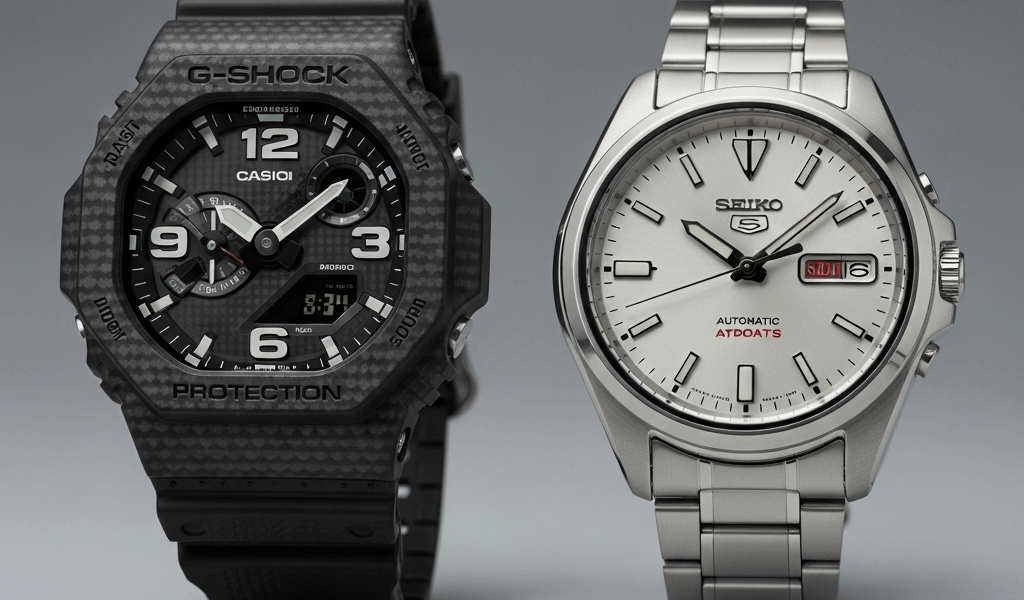
Casio G-Shock GA2100 vs Seiko 5 Sports — Quartz Tough or Mechanical Soul
Two Watches That Have Nothing to Do With Each Other
The GA2100 vs Seiko 5 Sports debate has gotten complicated with all the spec-sheet noise flying around. Forums will put these two side by side like they’re competing for the same crown — same price bracket, same “daily beater” label, same crowd arguing past each other until page seven of the thread. I’ve worn both. Not a five-minute try-on at a display counter, but months of actual wrist time, including some situations those watches probably didn’t enjoy. What I found is that comparing these two on specs alone completely misses what’s actually going on here.
This article includes affiliate links. We may earn a commission at no extra cost to you.
Our Top Picks
This section includes affiliate links. We may earn a commission at no extra cost to you.
Seiko SRPD65 5 Sports Automatic
Black dial, 100m water resistant, day/date, rotating bezel
$265.00
Check Price on AmazonThese are not competing watches. They represent two entirely different philosophies about what a watch is supposed to be.
The GA2100 — nicknamed the “CasiOak” for an octagonal bezel that rhymes visually with Audemars Piguet’s Royal Oak — is pure engineering. Built around protection, utility, precision. Runs quartz. Never needs winding. Survives things that would wreck most timepieces. The Seiko 5 Sports SRPD series, by contrast, is mechanical automatic. There’s a rotor spinning inside that case, powered by wrist movement — actual human motion, translated into timekeeping. It gains or loses a few seconds per day. It has an exhibition caseback that lets you watch the movement work. It connects to a century of watchmaking craft in a way a battery-powered module simply cannot.
Choosing between them isn’t about which is better. It’s about which kind of watch person you are — or which kind you want to become.
Build Quality and What It Actually Feels Like to Wear These
Worn side by side, the physical difference hits you immediately.
The GA2100 is resin and carbon fiber reinforced resin. Roughly 51 grams on the wrist. The Seiko 5 Sports — I was testing the SRPD55, stainless steel case, olive green dial — comes in around 130 grams with the bracelet. More than double. Neither weight is wrong, but the difference shapes the entire wearing experience in ways the spec sheets don’t tell you.
The GA2100 on Your Wrist
The GA2100 measures 48.5mm across but somehow wears smaller than that number suggests. The octagonal shape distributes itself cleanly against your wrist, the 11.8mm case height keeps it from snagging on jacket cuffs, and the light weight means you genuinely forget it’s there after twenty minutes. I wore mine through an entire day of moving apartments — carrying furniture down two flights of stairs, catching doorframes, sweating through August in a city that had no business being that humid. Didn’t think about the watch once. For a tool watch, that’s the ideal outcome.
The 200-meter water resistance isn’t just marketing copy. Gym sessions, swimming, rain, the inevitable kitchen sink incident. It’s passed Casio’s shock resistance testing — 10-meter drop onto concrete, specifically — and my unit took a cabinet corner at full speed around month two of ownership. Zero damage. Zero drama. I honestly expected at least a scratch.
The Seiko 5 Sports on Your Wrist
The SRPD55 wears its 130 grams with confidence. Heavier watches feel planted — there’s a reason serious collectors gravitate toward solid cases. The 4R36 movement inside is rated to 100 meters water resistance, which handles everyday splashes, rain, and handwashing without any anxiety. I wouldn’t take it surfing. I did wear it on a full day hike without a second thought.
The bracelet on the base Seiko 5 Sports is functional. It’s not exceptional. The links rattle slightly, which bothered me more than it probably should have. Don’t make my mistake of living with it for weeks — a $15 aftermarket NATO strap fixed the problem immediately and honestly made the watch look better anyway. Probably should have opened with that advice, since it’s the single easiest upgrade you can make to this watch.
Where the Seiko earns real points is in heritage. The case finishing, the applied hour markers, the way the dial catches light at different angles — at $250 to $320 USD retail for most SRPD variants, this watch punches considerably above its weight in visual quality.
Features Head-to-Head
The feature comparison between these two isn’t really fair, and that’s worth saying upfront. The GA2100 is a digital quartz module in an analog-display housing. The Seiko 5 runs a purely mechanical movement with no electronics whatsoever. Different tools for different jobs — and the table below reflects that pretty clearly.
| Feature | GA2100 | Seiko 5 Sports SRPD | Winner |
|---|---|---|---|
| Timekeeping accuracy | ±15 seconds/month (quartz) | +45/-35 seconds/day (mechanical) | GA2100 — not close |
| World time | Yes — 31 time zones | No | GA2100 |
| Stopwatch | Yes — 1/100 second | No | GA2100 |
| Countdown timer | Yes | No | GA2100 |
| Day-date display | Yes (digital sub-dial) | Yes (printed window, 4R36) | Tie |
| Hand-winding capability | No | Yes | Seiko 5 |
| Hacking (seconds stop) | No | Yes | Seiko 5 |
| Exhibition caseback | No | Yes | Seiko 5 |
| Battery life | Approximately 3 years | N/A — self-winding | Seiko 5 (never needs a battery) |
| Illumination | LED backlight | Lume on hands and indices | GA2100 for pure visibility |
| Shock resistance | Yes — G-Shock standard | No formal rating | GA2100 |
The honest takeaway from that table is simple: GA2100 wins on functionality, Seiko 5 wins on soul. Neither watch does everything. They each do their specific thing very well.
One mistake I made early on was assuming the Seiko’s 4R36 accuracy spec would drive me crazy coming from quartz. It did, at first. Lost about three minutes over two weeks before I regulated my winding habits and started wearing it more consistently. After that, running around +8 seconds per day became just a detail — one I either adjusted for or stopped caring about entirely. Apparently that’s the more common outcome among people who get into mechanical watches. The imprecision becomes endearing somehow. That’s what makes mechanical timekeeping endearing to us watch people, honestly — the humanness of it.
Which Watch Looks Better With What
This is where the comparison gets more interesting than spec sheets allow.
The GA2100 — Casual and Streetwear
The GA2100 in black-on-black — the GA2100-1A1 specifically — is a genuinely beautiful watch with jeans, joggers, a hoodie, any streetwear context. The octagonal bezel reads as architectural, almost fashion-forward, and the analog hands on a black dial give it a cleanliness most digital G-Shocks don’t have. Wore mine with Nike Dunk Lows and a plain crewneck one Saturday and got unsolicited compliments from two separate people who, as far as I could tell, don’t wear watches at all.
Business casual is a different story. Chinos, a button-down, leather shoes — the GA2100 starts to struggle here. The resin case reads casual immediately. The digital sub-dial breaks formality. It’s not unwearable, but you’ll notice the mismatch when you glance down during a meeting. With athleisure, technical gear, outdoor layers, casual weekend clothes though? One of the best-looking watches available at any price.
The Seiko 5 Sports — Smart Casual and Beyond
The Seiko 5 Sports SRPD lineup covers serious stylistic ground depending on which variant you choose. The SRPD55 in green with a steel bracelet is unambiguously sport-casual — works with chinos, casual blazers, smart-casual weekend outfits in a way the GA2100 simply cannot manage. The SRPD63 in blue dial reads almost dressy enough for a business meeting if you’re working somewhere with a creative dress code.
Neither watch belongs with a suit. Both are too casual for that. But the Seiko 5 stretches further up the formality scale. Put it this way — the Seiko is the watch I’d grab for a date where the dress code reads “smart casual.” The GA2100 is what I’d wear to that same restaurant if we were coming straight from the farmers market first.
The variety in Seiko 5 Sports colorways matters too. At least a dozen options at retail — field green, navy, black, silver, orange — each reading differently across outfit contexts. The GA2100 has color variants as well, but the resin construction caps its versatility ceiling regardless of which colorway you pick.
The Verdict — Pick Based on Your Actual Life
Here’s the decisive answer, broken down by who you actually are.
Buy the GA2100 if —
- You live an active outdoor lifestyle and your watch will face genuine physical punishment
- You travel across time zones regularly and world time actually matters day-to-day
- Your default wardrobe is casual, streetwear, or athletic clothing most of the week
- You want a watch you can completely forget about — no winding, no regulating, no battery anxiety for three years
- Your budget is tight and you want maximum durability per dollar spent (around $99 to $130 USD retail)
- You want one watch that handles the gym, the hike, the desk, and the weekend errands without a second thought
Buy the Seiko 5 Sports if —
- You want your watch to feel like something more than a device — something with actual history and craft inside it
- Your daily dress code hits smart casual at least a few times a week and you need a watch that rises to meet it
- You’re curious about mechanical watchmaking and want an exhibition caseback that lets you see how it works
- You want a watch that becomes more interesting over time — not just more scratched
- You’re the kind of person who won’t mind winding a watch in the morning, because that ritual becomes part of your day rather than a chore
- You want a foundation piece you’ll still respect as your taste in watches evolves
Frustrated by a previous watch that felt disposable and forgettable — a cheap quartz thing I’d picked up at an airport — I switched to the Seiko 5 Sports as my primary daily wearer for four months straight. What surprised me was how much the mechanical connection changed the experience of actually owning a watch. Picking it up each morning, winding it with thirty or forty turns of the crown, checking the movement through the caseback while drinking coffee — these became genuinely enjoyable small rituals. The GA2100 doesn’t offer that. It offers something entirely different: the confidence that no matter what happens that day, the watch survives it without you giving it a single thought.
Right now, in my actual life, I reach for the Seiko on workdays and the GA2100 on weekends and travel days. That split probably tells you everything useful about these two watches. If you can only have one, ask yourself honestly whether you want a tool or a companion. The GA2100 might be the best tool in its price range, as daily-beater ownership requires real durability — and the G-Shock standard delivers that in ways nothing else at $100 can match. The Seiko 5 Sports is simply the most human watch you can buy for under $300. Neither answer is wrong. They’re just different questions.



Stay in the loop
Get the latest ichronos updates delivered to your inbox.