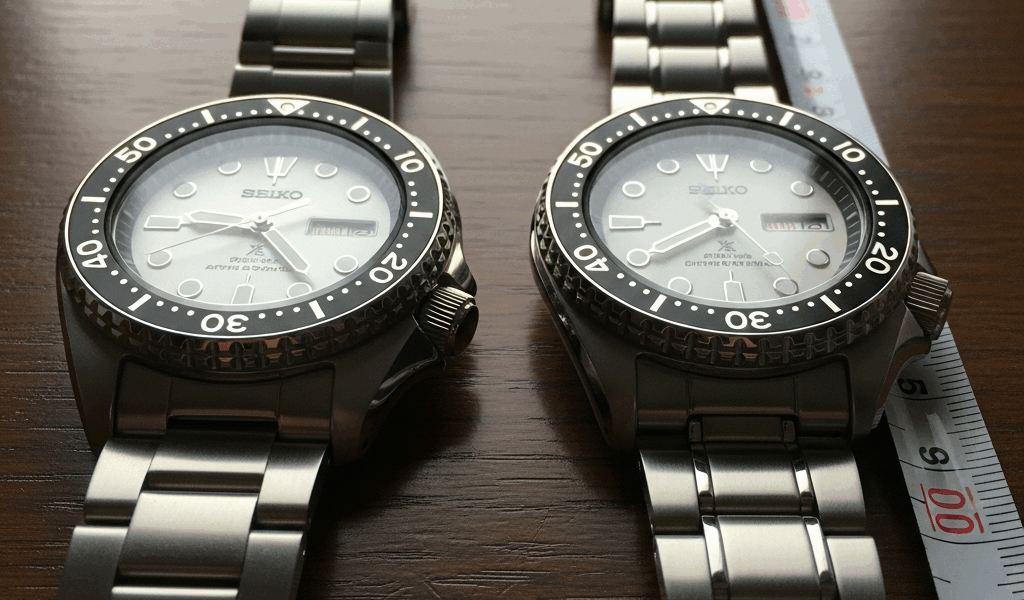
Seiko SKX013 vs SKX007 — Which One Should You Buy
The Seiko SKX013 vs SKX007 question has gotten complicated with all the conflicting forum noise flying around. As someone who bought the SKX007 first and spent three weeks convincing myself it didn’t look ridiculous on my wrist, I learned everything there is to know about this comparison the hard way. Today, I will share it all with you.
Here’s the short version of my mistake: I loved the SKX007 on paper. Then I strapped it on my 6.25-inch wrist and it sat there like a manhole cover. Sold it at a small loss, tracked down an SKX013, and immediately understood why people in the hobby quietly call it the sleeper of the two. Same watch, essentially. Different human.
The One Difference That Actually Matters
Every comparison online leads with case diameter — 42mm for the SKX007, 38mm for the SKX013. That number matters. But it’s not the number that tells you whether a watch will look right on your specific wrist. Lug-to-lug is.
The SKX007 runs approximately 46.5mm lug-to-lug. The SKX013 comes in around 44mm. That 2.5mm gap sounds minor. It isn’t — at least not on wrists under about 6.5 inches in circumference. Those extra millimeters are the difference between a watch that sits inside the wrist and one that bridges over the edges of it. Bridging is the death of a good watch on a smaller wrist. It shifts. It angles. It never looks intentional, no matter how much you want it to.
Lug-to-lug is a function of both case diameter and how far the lugs extend outward from the case body. Seiko’s designers clearly understood the SKX013 needed different proportions for a different customer. The result is two watches sharing nearly every internal component — wearing like they were built for different species of humans.
That’s the real tension here. Not spec differences. Audience differences. That’s what makes this comparison endearing to us watch nerds who obsess over millimeters at midnight.
Dial, Bezel, and Crystal — Spot the Differences
Probably should have opened with this section, honestly — because plenty of buyers assume the dials are identical and they’re not quite.
The SKX013 dial is more compact. Indices are slightly smaller. The dial text — “AUTOMATIC,” “DIVER’S 200M,” the Seiko name — arranges itself in a marginally tighter layout. It doesn’t look cramped. It looks proportionate. The SKX007’s dial has more breathing room, which reads as bold and assertive from across a table.
The chapter ring — that inner bezel ring with the minute markers printed on it — differs slightly between the two. Both are present. Both are functional. The SKX013’s is scaled to its smaller case. Neither version is better. They’re just sized for their respective homes.
What is identical, for buyers wading through Reddit threads full of conflicting information:
- Both run the Seiko 7S26 automatic movement, rated to approximately ±15 seconds per day — non-hacking, non-hand-windable
- Both use LumiBrite on the hands and indices, which is genuinely good lume by any reasonable standard
- Both feature a unidirectional rotating bezel with 120 clicks
- Both use a Hardlex crystal, not sapphire
- Water resistance is 200 meters on both
The bezel action on both is satisfying — positive, clicky, no backplay worth complaining about. Neither watch is going to win awards for finishing. Brushed cases, minor polished accents, workmanlike execution. This is a tool watch. Not a dress watch pretending to be tough.
Bracelet and Strap Options on Each Model
But what is the real ownership difference between these two? In essence, it’s the lug width — and it’s much more than that once you’re deep into the strap rabbit hole.
Both watches ship on an oyster-style bracelet — the familiar H-link design Seiko uses across much of its lineup. The SKX007 uses a 22mm lug width. The SKX013 uses 20mm. That gap matters more than it should.
Twenty-two millimeters is the sweet spot for aftermarket straps. Virtually every major strap maker — Barton, Crown and Buckle, Everest, the entire Etsy diver-strap ecosystem — works at 22mm. A $15 NATO or a $90 leather rally strap in 22mm takes about four minutes to find. The SKX007 is as strap-friendly as watches get at this price point.
Twenty millimeters is common. Just not as abundant at the enthusiast level. Fewer boutique choices. Sometimes slightly higher prices for the same quality tier. Not a dealbreaker — worth knowing before you budget for straps, though. Don’t make my mistake of assuming 20mm has the same selection depth.
I’m apparently a 20mm NATO person and the Hirsch Diver works for me while the SKX007’s stock bracelet never felt quite right. Popular pairings worth knowing about: the SKX007 looks excellent on a 22mm Seiko rubber dive strap, Ref. DAL1Z specifically, or an Everest curved end link band around $65 to $75. The SKX013 pairs well on a 20mm Bond NATO or that same Hirsch Diver rubber — both sit proportionally right on the smaller case.
One shared flaw: the bracelet end-links on both watches. They don’t sit flush against the case on most examples — there’s a visible gap. Known issue. Widely documented. Widely accepted as a quirk of the price point. Aftermarket end-links from Dagaz or Sam’s Worn Watch Parts fix it for around $25 to $35. Budget for it if the gap bothers you.
Who Should Buy the SKX013 and Who Should Buy the SKX007
So, without further ado, let’s dive into the actual buying decision.
Wrist under 6.5 inches — stop reading and buy the SKX013. The 44mm lug-to-lug sits within the wrist. The proportions work. You won’t spend months second-guessing it the way I did during my SKX007 phase. First, you should measure your wrist circumference — at least if you want to avoid the exact situation I described in the opening paragraph.
Average wrist, roughly 6.5 to 7 inches — this is where the tradeoff is genuinely real. The SKX007 has presence. It reads as a dive watch from across a dinner table. The SKX013 feels more comfortable through a long day wearing it. Neither choice is wrong. The question is whether you want a watch that announces itself or one that disappears into your wrist in the best possible way.
Wrist over 7 inches — the SKX007 is your default. The SKX013 will look undersized and slightly out of proportion. Go with the larger case and don’t overthink it.
| Spec | SKX013 | SKX007 |
|---|---|---|
| Case Diameter | 38mm | 42mm |
| Lug-to-Lug | ~44mm | ~46.5mm |
| Lug Width | 20mm | 22mm |
| Weight (with bracelet) | ~100g | ~113g |
| Market Price Range (2025) | $250–$400 used | $180–$350 used |
The SKX013 is consistently harder to find in good condition — budget an extra two to four weeks if you’re hunting for a clean example. The market is not large and patient sellers know what they have.
Current Prices and Where the Market Sits in 2025
Both the SKX013 and SKX007 were discontinued by Seiko — replaced effectively by the 5KX and SRPD lines. New old stock exists but it’s thinning out fast, and “new” pricing is grey market territory now. That was probably inevitable once Seiko pulled them from official channels.
Frustrated by inflated grey market prices, most buyers end up on eBay or Chrono24 — which is honestly where you should be looking anyway. Here’s the real picture:
- SKX007 used, good condition: $180 to $300 on eBay, $220 to $350 on Chrono24
- SKX013 used, good condition: $250 to $350 on eBay, $300 to $420 on Chrono24
- Grey market new old stock, either model: $300 to $500 depending on seller and condition of box and papers
The SKX013 commands a premium purely on scarcity and small-wrist demand. The market knows exactly who’s searching for it — and prices accordingly.
When buying used, look at dial condition first. Fading lume plots or discoloration around the indices are common on older examples and aren’t cosmetically fixable without a full dial swap. Check bezel click action in seller videos. Pass on any listing that won’t show the caseback or movement condition. A heavily worn watch is fine. A watch that’s been improperly serviced by someone’s cousin is a problem.
The verdict, stated plainly: wrist under 6.5 inches — hunt down an SKX013 and pay the premium without regret. Wrist average or larger — the SKX007 is more available, cheaper, and carries a deeper strap aftermarket. Buy that one and put the price difference toward a decent strap. Probably the Everest band. You’ll thank yourself later.

Stay in the loop
Get the latest ichronos updates delivered to your inbox.