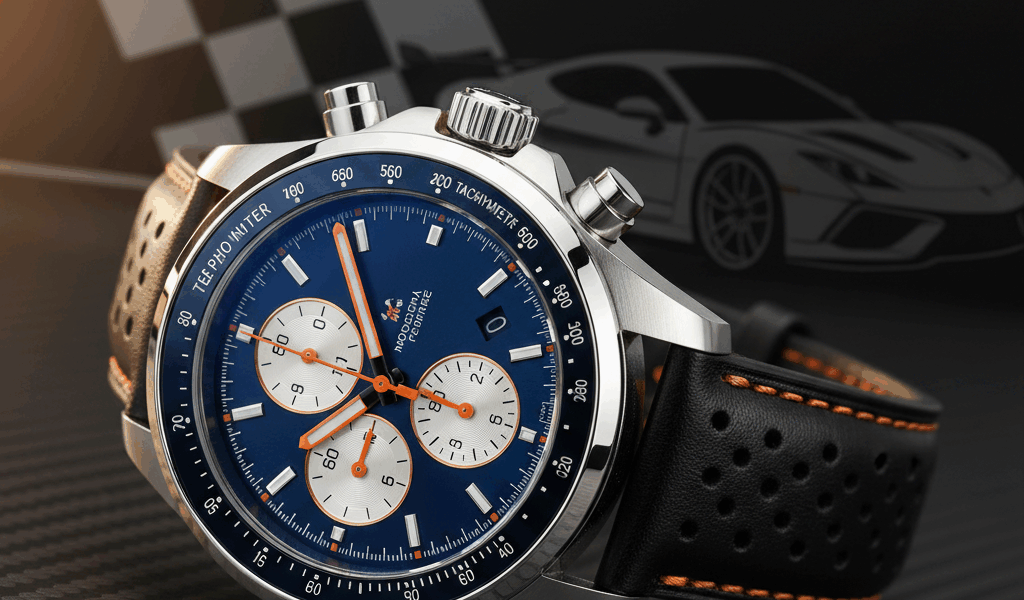
Chronograph complications have gotten complicated with all the scale markings and subdial configurations flying around. As someone who has spent years learning what all those numbers around the dial actually mean, I learned everything there is to know about these tools. Today, I will share it all with you.
That busy dial with scales running around the chapter ring isn’t just decoration. Tachymeters, pulsometers, and telemeters were serious professional tools before smartphones made calculations instant. Understanding these scales reveals how analog watches served as computational instruments and explains why racing chronographs look the way they do.
The Tachymeter: Measuring Speed
Probably should have led with this section, honestly. The tachymeter is the most common chronograph scale, found on everything from Omega Speedmasters to inexpensive fashion chronographs. It measures speed over a known distance, most commonly one mile or one kilometer. The principle is simple: start the chronograph at a mile marker, stop at the next mile marker, and the second hand points to your average speed in mph.
The scale itself works through mathematical inversion. At 60 seconds, the scale reads 60 units per hour. At 30 seconds, it reads 120. At 45 seconds, it reads 80. The formula is 3600 divided by the elapsed seconds. This logarithmic relationship explains why tachymeter scales compress at higher speeds and spread at lower ones.
Practical limitations exist. Most tachymeters only function for events lasting between 7-60 seconds, corresponding to speeds of roughly 60-500 units per hour. Below 60 units, the elapsed time exceeds one minute and the scale doesn’t apply directly. Above 500 units, the elapsed time is so brief that reaction time errors dominate.
For everyday use, the tachymeter can measure anything per hour. Time how long it takes to produce one unit of anything, and the scale gives you units per hour. One coffee brewed in 40 seconds means 90 coffees per hour, if you could maintain that pace.
The Pulsometer: Medical Precision
That’s what makes pulsometer scales endearing to us watch history enthusiasts—before digital pulse oximeters, physicians used these scales to quickly measure heart rate. The principle is similar to tachymeters but calibrated for counting heartbeats. The most common calibration is “30 pulsations,” meaning you start the chronograph, count 30 heartbeats, stop, and read the pulse rate directly.
Different calibrations exist. Some vintage doctor’s watches use 15 pulsations for faster readings at the cost of precision. Others use 20 pulsations as a compromise. The scale mathematics adjust accordingly, trading accuracy for speed of measurement.
The pulsometer fell from medical use decades ago but remains on specialty chronographs as historical tribute. Omega and Longines offer modern pulsometer-equipped watches for collectors who appreciate the medical heritage or simply enjoy the distinctive dial appearance.
The Telemeter: Measuring Distance
The telemeter scale measures distance using the speed difference between light and sound. Start the chronograph when you see a lightning flash or artillery muzzle blast, stop when you hear the thunder or explosion, and the scale indicates distance in kilometers or miles.
The calculation uses sound’s speed at sea level (approximately 343 meters per second or 1,125 feet per second). At 3 seconds elapsed, sound has traveled roughly 1 kilometer. At 5 seconds, about 1.7 kilometers. Telemeters were genuinely useful for military artillery spotting and meteorological work.
Modern applications are limited, but telemeters still work perfectly for estimating thunderstorm distance. The old “count seconds between flash and thunder, divide by five” rule approximates the same calculation less precisely than a proper telemeter scale.
Racing Chronograph Design Philosophy
Racing chronographs combine these scales with emphasis on legibility at speed. Contrasting subdials (panda or reverse panda configuration) improve chronograph hand visibility. Large cases allow bigger scales with finer graduations. Red accents on running seconds or chronograph elements provide quick visual reference.
The Rolex Daytona, Omega Speedmaster Racing, and TAG Heuer Carrera established the racing chronograph aesthetic with bold, high-contrast dials designed for quick glances while driving. Modern pieces continue this tradition even though contemporary racing relies on electronics rather than analog chronographs.
Using Scales Effectively
Accurate use requires proper technique. For tachymeters, use exactly one mile or one kilometer, not estimates. Highway mile markers work perfectly. For pulsometers, practice consistent beat counting, as miscounting by even two beats introduces significant error. For telemeters, understand that temperature and altitude affect sound speed slightly.
The chronograph itself must run accurately. A chronograph that gains time while running will produce progressively worse scale readings. High-beat movements (28,800 vph or higher) provide finer resolution than low-beat vintage calibers.


Stay in the loop
Get the latest ichronos updates delivered to your inbox.