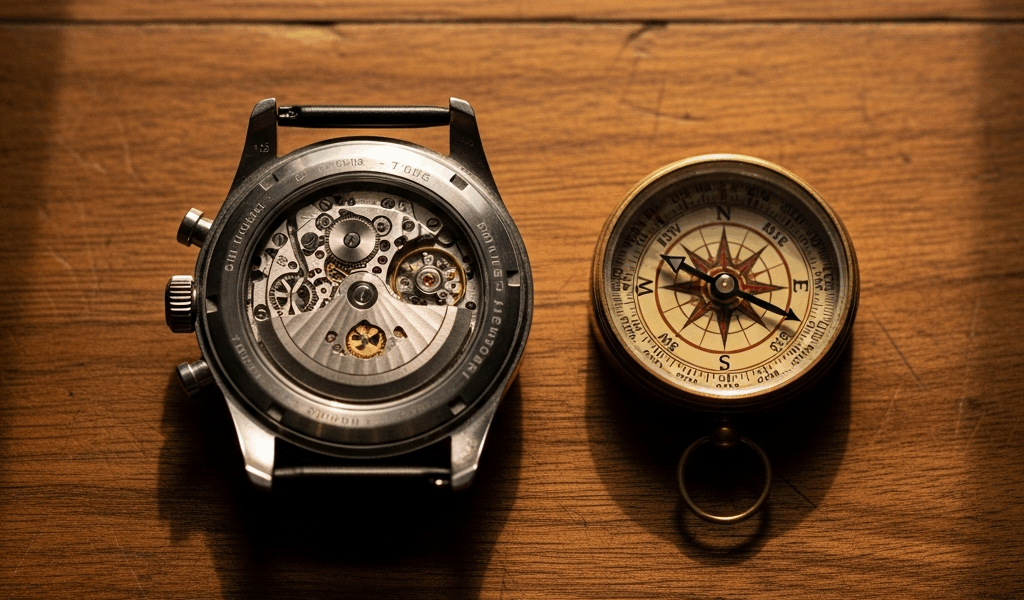
Your automatic was keeping perfect time last week. Now it is gaining five minutes a day and the second hand occasionally stutters like it forgot what it was doing. Something changed — and it probably was not the movement wearing out. Nine times out of ten, the culprit is magnetism. The good news? You can fix it at home in about thirty seconds flat.
How to Tell If Your Watch Is Magnetized
The dead giveaway is sudden, dramatic time gain. Not the gradual drift of a few seconds per day that every mechanical watch does naturally — that is just regulation being regulation. Magnetization causes your watch to gain minutes. Five, sometimes ten in a single day. What happens is the coils of the hairspring start sticking together when magnetized, which effectively shortens the spring and makes the balance wheel oscillate faster than it should. Faster oscillation means the watch thinks time is moving quicker than it actually is.
Second symptom worth watching for: erratic second hand behavior. The sweep might hesitate, jump ahead two ticks, or stutter at random intervals. This is different from the normal six-beat-per-second stepping you see when you look closely at a 21,600 vph movement. Magnetized stuttering is irregular and unpredictable — the hairspring coils are intermittently touching each other as the spring breathes in and out.
In really bad cases, the watch just dies. Strong enough magnetism locks the hairspring coils together so tightly the balance wheel physically cannot oscillate. If your watch was running fine yesterday, sat next to something overnight, and is now showing a full power reserve but will not tick — magnetism is suspect number one.
Here is the detail that trips people up: a magnetized watch almost always runs fast, not slow. If yours suddenly started losing time instead, you are more likely looking at a mainspring issue, shock damage, or a movement that is due for its service interval. Magnetization and running fast go together like peanut butter and jelly.
The Compass Test and Smartphone Test
You do not need to guess about this. Two quick tests give you a clear answer, and both take under a minute.
The compass method: Grab a small compass and set it on a flat surface. Let the needle settle pointing north. Now slowly bring your watch toward the compass, caseback first — that puts the movement closest to the needle. If the compass needle swings toward your watch or starts spinning as you approach, congratulations, your watch is magnetized. A clean watch will have virtually zero effect on that needle until you are practically touching it. I keep a cheap dollar-store compass in my watch box specifically for this. Cost me $1.50 and it has saved me a trip to the watchmaker more than once.
The smartphone method: Your phone already has a magnetometer sensor built in — it uses it for the compass app. On iOS, download LEPSI. It gives you a real-time gauss reading that updates as you move the phone. On Android, Physics Toolbox Magnetometer does the same thing. Open the app, hold the phone away from all metal to get a baseline reading, then slowly bring your watch caseback toward the top edge of the phone (that is where the sensor usually lives). A spike of more than 5-10 microtesla above your baseline suggests magnetization. If the reading jumps 50 or more above baseline, your watch is definitely magnetized and needs attention.
Fair warning on the phone test: phones themselves contain magnets — speakers, haptic motors, MagSafe rings on iPhones. You need that clean baseline first or you will chase phantom readings.
How to Demagnetize Your Watch at Home

Here is the part where you relax, because this fix costs less than lunch. You need a watch demagnetizer — a small electronic gadget that generates an alternating magnetic field to scramble and neutralize the residual magnetism in your movement. The Bergeon 2321 is what real watchmakers use, though at $60-80 it is overkill for most people. Perfectly good alternatives live on Amazon for $15-25, and they work fine for the once-or-twice-a-year demagnetization that most watch owners need.
The actual process is laughably simple. Turn on the demagnetizer. Place your watch flat on top of it with the caseback down so the movement sits closest to the field. Wait two or three seconds. Then — and this is the part that matters — lift the watch straight up slowly, pulling it at least twelve inches above the device before you set it down anywhere. That gradual pull-away is doing the real work. The alternating field progressively reduces the magnetization to zero as you increase distance. If you yank the watch off fast, you can leave residual magnetism behind.
Run the compass test again afterward. The needle should barely twitch when your watch approaches. Set the time, wear it for a day, and check your accuracy. If you are back to gaining or losing a handful of seconds instead of minutes, you are done. Whole thing takes maybe thirty seconds of active effort.
You might stumble across old forum posts recommending a CRT television for demagnetization — those tube monitors had degaussing coils built in that could do the trick. Since CRTs have been extinct for fifteen years now, this advice is roughly as useful as suggesting you use a carrier pigeon. Get the dedicated tool.
What Magnetizes a Watch in the First Place
Modern life is absolutely lousy with magnets, and most of them are invisible. Here are the usual suspects, ranked roughly by how aggressively they will mess with your movement.
MRI machines: If you work in a medical facility and forgot to take your watch off before walking into an MRI suite, it is now very magnetized. MRI fields are thousands of times stronger than anything else on this list. You do not even need to be inside the machine — just being in the room can do it.
Speaker magnets: Bluetooth speakers, soundbars, earbuds sitting in their charging cases. The neodymium magnets in modern audio equipment are shockingly powerful for their size. I magnetized a Seiko 5 by leaving it on top of a speaker overnight. Took roughly eight hours to go from keeping great time to gaining seven minutes a day. Lesson learned the hard way.
Laptops and tablets: MacBooks use magnets for the lid closure sensor. iPads use them for Smart Cover attachment and Apple Pencil charging. Resting your wrist on the laptop keyboard while typing, or setting your watch down on an iPad — these small repeated exposures add up over days and weeks.
Magnetic phone mounts and cases: MagSafe cases and magnetic car mounts put strong magnets right where your watch might sit on your wrist or in the same pocket during travel. I have seen people magnetize a watch just by keeping it in the same jacket pocket as a MagSafe-equipped iPhone.
Handbag and wallet clasps: Magnetic clasps on bags, leather folios, and clutch wallets. If you travel with your watch loose in a bag, it can end up resting against a clasp magnet for hours without you realizing it.
The danger zone is roughly within one centimeter of the magnet. Beyond about five centimeters, most household magnets lose the ability to permanently magnetize a watch movement. The problem is that daily life constantly brings magnets inside that one-centimeter boundary without you ever noticing.
Watches That Resist Magnetization
If you work around magnets regularly — hospital staff, audio engineers, anyone with a MagSafe addiction — some watches are specifically built to shrug this whole problem off.
The benchmark is Omega’s Master Chronometer certification, which means the movement resists magnetic fields above 15,000 gauss. For perspective, the average fridge magnet produces about 50 gauss. These movements use silicon hairsprings and non-ferromagnetic escapement components — the parts that normally get magnetized simply cannot be magnetized because the materials are not susceptible. The Omega Aqua Terra and Seamaster collections carry this certification across most references.
Rolex built the Milgauss specifically for scientists working around electromagnetic equipment. The name is French for “thousand gauss,” and it achieves resistance through a soft iron shield inside the case that redirects magnetic fields around the movement like water flowing around a rock. The green sapphire crystal variant is the collector favorite, but every Milgauss shares the same protective architecture.
Sinn takes a more pragmatic approach with soft iron inner cases on models like the 556 and 856. The entire movement sits inside what amounts to a Faraday cage — magnetic fields hit the iron liner and flow around the movement rather than through it. You get serious protection at a lower price than Omega or Rolex, which makes Sinn popular with people who need magnetic resistance but are not buying luxury watches.
On the budget end, any watch running a silicon hairspring gets inherent magnetism resistance because silicon is not ferromagnetic — it physically cannot hold a magnetic charge. The Tissot Powermatic 80 SiH movement uses one, as do several Frederique Constant Slimline models. You are not getting the 15,000-gauss fortress that Omega offers, but for everyday magnetic exposure from laptops and phone cases, a silicon hairspring handles it without breaking a sweat.
If your current watch has none of these features, do not panic. A $20 demagnetizer in your drawer and a compass test once a month will catch the problem long before it causes you any real grief. Magnetization is common, easy to diagnose, and trivial to fix — the only real mistake is not knowing what it is.

Stay in the loop
Get the latest ichronos updates delivered to your inbox.