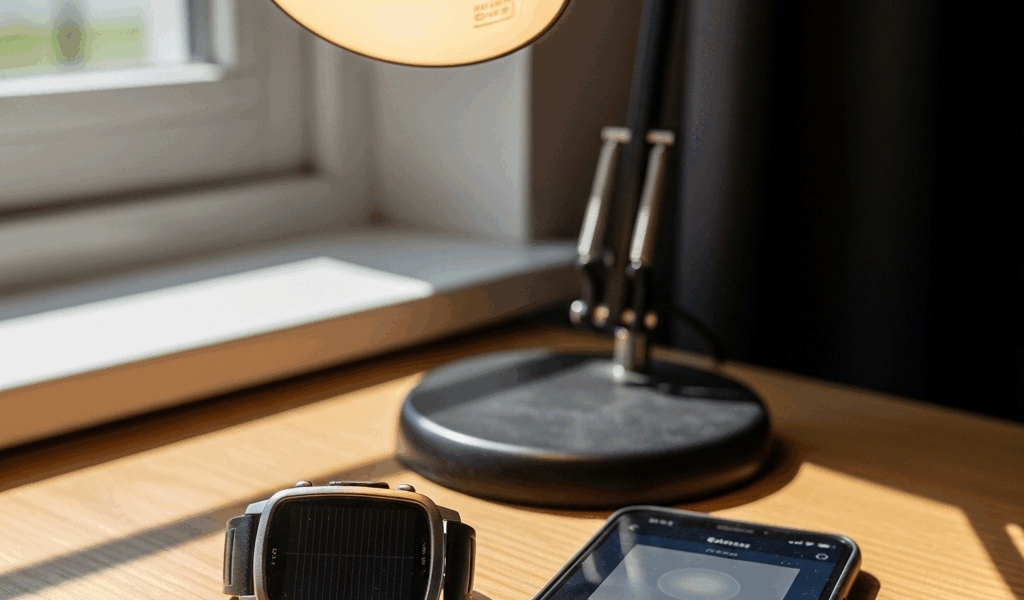
How Eco-Drive Charging Actually Works
Eco-Drive charging has gotten complicated with all the misinformation flying around. People treat these watches like dead quartz pieces the moment they stop ticking. That’s the wrong instinct entirely.
But what is an Eco-Drive, really? In essence, it’s a solar-powered quartz watch that stores energy in a rechargeable capacitor instead of a disposable battery. But it’s much more than that — it’s a sealed system with no user-serviceable battery door, which means when something goes wrong, most owners have no idea where to start.
Here’s the basic loop: light hits solar cells embedded beneath the dial. You won’t see them on most models. They’re hidden under the watch face, completely invisible. That light triggers a conversion process inside the cell, pushing electrical current into a small cylindrical capacitor — think of it as a fuel tank about the size of a pencil eraser. The capacitor charges. The movement runs. Clean and self-contained, until it isn’t.
A lot of Eco-Drive models include a charge indicator hand — a thin secondary hand that creeps forward as energy fills the capacitor. If yours has one and it hasn’t moved in days, that’s your first real clue. A fully charged capacitor can power the watch in total darkness for anywhere between 6 months and 4 years depending on the model. A degraded capacitor, though? It won’t hold that energy no matter how much light you throw at it. That distinction matters more than anything else in this guide.
Most Common Reasons Your Eco-Drive Is Not Charging
Insufficient Light Exposure — 60% of Cases
This one gets almost everyone. I made this exact mistake with a Promaster I inherited from my uncle — wore it indoors for nearly three weeks, kept checking the charge hand, couldn’t figure out why nothing was moving. The watch wasn’t broken at all. It was starving.
Office fluorescent bulbs don’t cut it. Your desk lamp doesn’t cut it. Even a well-lit kitchen barely registers on the solar cell’s sensitivity range. Direct outdoor sunlight is orders of magnitude more powerful than any indoor light source. If your Eco-Drive hasn’t seen unobstructed sun in several weeks, the capacitor is probably depleted. The watch stopped. It won’t restart from wrist wear alone inside a building. That’s the pattern.
Don’t make my mistake. Five hours of actual sunlight — not a window pane, not a lamp — should be your first move before assuming anything is wrong.
Watch Face Obstruction — 20% of Cases
Citizen makes some genuinely beautiful Eco-Drives. Black dials, ceramic bezels, busy printed faces — they look incredible on the wrist. They also charge slower than a plain white-dial model by a meaningful margin. Dark dials absorb light before it reaches the solar cells underneath. That’s just physics.
Equally important: a scratched or hazed crystal blocks light transmission too. Hold the watch up at an angle against a bright window. If the crystal looks milky, cloudy, or visibly scratched across the surface, you’re losing charging efficiency with every passing month. It compounds gradually — the kind of problem that sneaks up on you.
Symptom here is usually sluggish charging rather than complete failure. The watch runs for a few days then stops. Or it only recovers charge after 8-plus hours of direct sun instead of the usual 2 or 3.
Worn Capacitor — 15% of Cases
Every capacitor has a fixed lifespan. A standard Eco-Drive capacitor holds up for roughly 10 to 15 years under normal conditions. After that window, the internal chemistry degrades. It simply can’t retain a charge anymore — full stop.
The symptom is distinctive once you know what to look for. The watch charges fine. The charge hand climbs to the top. It runs for 2 or 3 days, then stops dead. You charge it again. Same cycle. No gradual slowdown, just sudden powerlessness on a predictable loop. That’s capacitor failure — and more sunlight won’t solve it.
Corrosion or Water Damage — 5% of Cases
Water intrusion is subtle damage. The case held. The watch technically survived the splash or the swim. But moisture got inside and corroded the connection between the solar cell and the rest of the movement. The charging circuit is compromised even if nothing looks wrong from the outside.
Symptom: erratic charging that started noticeably after a significant water exposure, or faint discoloration visible near the dial edges under the crystal. Sometimes you’ll see it; sometimes you won’t until a watchmaker opens the case.
Step-by-Step Charging Diagnosis at Home
Probably should have opened with this section, honestly. Most people skip straight to conclusions and assume the watch is dead. Run through these steps first.
- Expose to direct sunlight for 5 hours minimum. Not a bright room. Not a south-facing window. Actual outdoor sunlight, dial facing the sky. Midday hours work best — sun angle is steepest between 10 a.m. and 2 p.m. Five unobstructed hours should recover a partially depleted capacitor. A watch that’s been sitting in a drawer since October needs this baseline test before anything else.
- Check the charge indicator hand if your model has one. After that sun exposure, did the thin hand move forward at all? Even a small tick counts. Movement means the solar cell and capacitor are both functioning. No movement after 5 full hours of direct sun — suspect either a corroded solar cell or a completely dead capacitor.
- Run the watch in darkness for 24 hours after charging. Pull it off your wrist, put it in a drawer or a box, leave it alone. Still running after a full day? Your capacitor holds charge. Stops within 6 hours? The capacitor is failing. A healthy Eco-Drive should stay running for at least 3 to 4 days in total darkness after a solid charge.
- Try a UV lamp if you can’t access direct sun. A 9-watt UV lamp — the kind sold for mineral and gem inspection, usually around $18 to $25 online — held about 2 inches from the dial for 2 hours can approximate strong sunlight well enough to move a charge indicator hand. A high-output LED grow light works similarly. Not a perfect substitute, but it confirms whether the circuit is alive when outdoor sun isn’t an option.
When the Capacitor Needs to Be Replaced
So the watch survived the 5-hour sunlight test. The charge hand moved. But it barely runs afterward, or it drains completely within 2 days on a repeating cycle — and the watch is from 2009 or earlier. That’s a worn capacitor. Sunlight won’t fix it.
Authorized Citizen service centers charge somewhere between $150 and $250 for capacitor replacement, plus shipping — usually a $20 to $40 mail-in fee each direction. Turnaround runs 3 to 4 weeks typically. Independent watchmakers vary a lot by region but often land between $100 and $180 for the same job. Citizen’s official mail-in service exists specifically for this — you can ship directly without hunting for a local service center.
The economics are worth thinking through clearly. A $1,200 Promaster or Skycycle? Replace the capacitor without hesitation. It restores a serious watch to full function. A $150 entry-level Eco-Drive from 2008? That repair cost starts to compete with the price of a new watch. I’m apparently sentimental about old timepieces and always lean toward repair — but a brand-new Citizen works for me while a 15-year-old budget model never quite recaptures what it was. Your math may differ.
Do not attempt a DIY capacitor swap. The solar cell connector is genuinely fragile, and disturbing it risks permanent damage to the charging circuit. This is a job for someone with the right tools and case-opening experience.
Keeping Your Eco-Drive Charged Long-Term
Real prevention is simpler than repair. Wear the watch regularly — that’s most of it. If your wrist sees any daylight during normal life, the capacitor stays reasonably topped up without any deliberate effort. A lunch break outside a couple of times a week is more than enough for most people.
If you’re storing it unworn for a while, keep it near a window rather than in a drawer. A watch sitting in complete darkness will fully deplete within 4 to 6 months depending on its charge at storage. The same watch sitting on a shelf near a south-facing window stays partially charged passively — no intervention needed.
Skip the watch rolls and zippered travel cases for long-term storage. They block all light. A small desk stand near natural light is genuinely the ideal setup for an Eco-Drive you’re not currently wearing.
One last thing worth knowing: most Eco-Drive models enter a power save mode after roughly 72 hours of darkness. The second hand starts ticking once every 2 seconds instead of continuously. That’s what makes Eco-Drive endearing to us watch people — even when it looks broken, it’s usually just being clever. New owners panic and assume the movement has failed. It hasn’t. The watch is conserving its remaining charge. Bring it into light and normal operation resumes within minutes. So, without further ado — get it outside.


Stay in the loop
Get the latest ichronos updates delivered to your inbox.