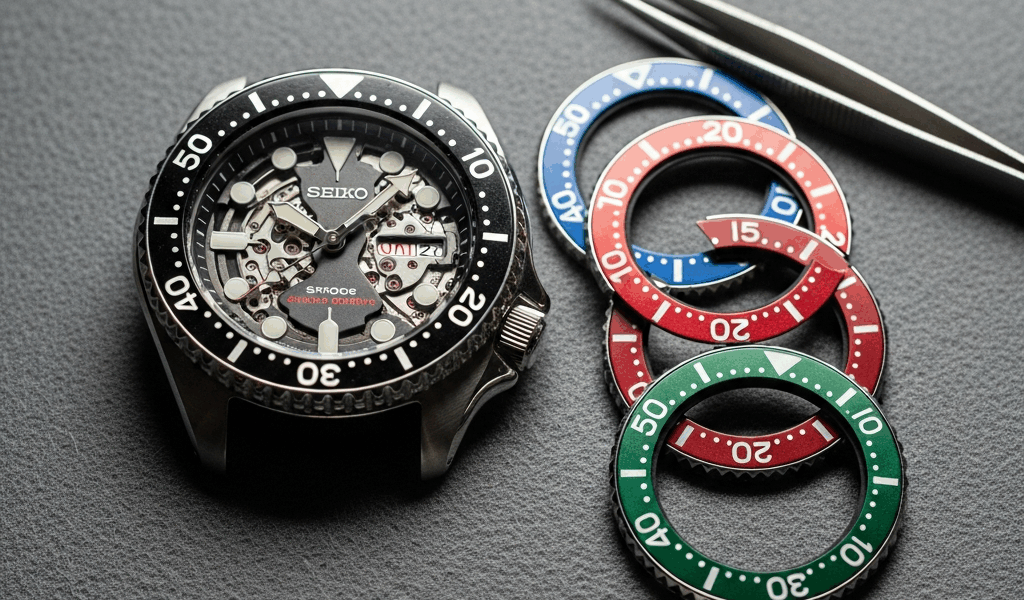
Seiko SKX007 Bezel Insert Replacement Step by Step
SKX007 bezel inserts have gotten complicated with all the conflicting advice flying around. As someone who’s swapped the same insert four times on the same watch, I learned everything there is to know about this process. Today, I will share it all with you.
This article includes affiliate links. We may earn a commission at no extra cost to you.
Two swaps were cosmetic — I wanted a different color scheme. One was because the lume turned that sickly green-yellow. And once because I pressed the insert in crooked and refused to live with it for the next decade.
Most guides skip straight to the good part and leave out everything that actually goes sideways. This one won’t. You probably already own the watch. You’re either bored with the stock insert or something’s damaged. The good news: totally doable at home. The real news: a few millimeters of misalignment or the wrong insert thickness will make you want to throw the thing across the room. So, without further ado, let’s dive in.
What You Need Before You Start
Gather everything first. Halfway through is genuinely the worst time to realize you’re missing something.
- A replacement insert — have it physically in hand before you touch your watch. We’ll talk quality later.
- A plastic pry tool or case knife — the Seiko case knife runs about $12 and it’s worth every cent. A butter knife works if you tape the bezel edges first and stay honest with yourself about your technique.
- A bezel press or DIY alternative — this is where most people get stuck, honestly. A proper Seiko bezel press runs $40–60. A die set from Amazon goes for $15–30. A wooden block and hammer works. Even a leather pad and steady hand pressure works — at least if the insert isn’t fighting you hard.
- Rodico or museum putty — about $5 for a small tin, and it lets you press the pip without denting anything or leaving fingerprints everywhere.
- Masking tape — protect the case from your tool slips. Don’t skip this.
- Magnifying glass or loupe — optional, but genuinely game-changing for alignment checks.
But what is the insert thickness problem? In essence, it’s a manufacturing variance issue. But it’s much more than that. Aftermarket inserts vary wildly — some run 0.2mm too thick, some sit 0.1mm too thin. The SKX007 bezel spring is tight but unforgiving. A thick insert ejects itself under wrist rotation. A thin one rattles from day one. More on that shortly.
You do not need a professional press. Patience and the ability to apply even, gradual pressure — that’s the whole skill set. If you have those, you’re fine.
How to Remove the Old Bezel Insert
This step confuses beginners. The bezel ring itself comes off first. The insert lives underneath it.
Remove the watch. Lay it dial-down on a soft surface — a folded towel or cloth mat works. Tape around the case edges so small parts have somewhere to land if they slip.
Find where the bezel ring meets the case. There’s a tiny gap there. Insert your plastic tool into that gap, gently. The bezel isn’t glued — it’s held by friction and a shallow spring underneath. Work the tool around the full bezel edge, applying light upward pressure. You’re coaxing it. Not prying it like you’re opening a paint can.
After two or three careful rotations, it pops free. Takes maybe three minutes if you stay patient. Rushing this step is how people permanently gouge their bezels. Don’t make my mistake.
Once the ring is off, the insert just sits there loose. Lift it straight out. Done.
If the bezel is absolutely stuck — and some SKX007s from certain production runs are stubborn — a little heat helps. Warm water or a hair dryer on low for thirty seconds. The case expands fractionally, friction releases, bezel lifts. Do not torch it. Do not force it.
Fitting the New Insert Without Screwing It Up
Probably should have opened with this section, honestly. This is where the actual work lives.
Before pressing anything, drop the new insert into the bezel ring and let it sit. Look straight down from above. Misalignment is obvious at this stage — one edge will sit higher than the opposite side. If that’s the case, pull it out and check the underside. Debris catches under inserts constantly. A single dust particle changes everything.
Use rodico to clean the bezel ring’s interior surface. Roll it gently across the whole area. You’re lifting dust, not scrubbing.
Set the insert in again. Check alignment. It should sit flush with zero rocking.
Now press it. If you have a die set, use the largest die that clears the dial and case — contact the insert only. If you’re using hand pressure or a wooden block, start at the pip end. Use rodico as your contact point. It distributes pressure evenly and prevents denting.
Apply steady downward pressure. Not fast. Gradual and controlled. You’ll feel it seat progressively — and when it’s fully home, there’s an audible click or a felt snap. The bezel spring settles, the insert locks into the retaining ring. That’s your confirmation.
I’m apparently someone who presses things slightly crooked without noticing, and the Dagaz insert works for me while cheaper generics never seat cleanly. Don’t make my mistake — check pip alignment against 12 o’clock before calling it done. If the insert looks rotated, pop the bezel back off, remove the insert, try again. The insert releases easily once the bezel ring is off. It’s the full assembly that’s tight.
Done carefully, this is a five-minute job. Done carelessly, it’s forty-five minutes of disassembling and retrying.
Insert Keeps Popping Out — Here Is Why
You did everything right and the insert still ejects under normal wear. Three things cause this.
The bezel spring is worn. Older SKX007s suffer this especially. The spring loses tension over years — no snap when you seat the insert, just play. A replacement bezel assembly from eBay runs $20–40 for a used one. Nuclear option, but it works.
Your aftermarket insert is too thick. This is the most common culprit. Some suppliers cut inserts at 1.3mm when Seiko’s spec is 1.1mm. The spring can’t fully compress, and under wrist movement, it gives up and ejects. Measure your insert with calipers before pressing. Anything over 1.15mm needs the underside sanded with 400-grit paper until it hits 1.1mm. Test fit before full assembly.
Debris between the insert and spring. You cleaned the top surface but missed the underside of the insert itself. Old lume, dust, dried adhesive from the previous insert — any of it prevents full seating. Wipe the underside with a soft cloth and a small amount of mineral spirits. Let it dry completely before pressing.
If all three are eliminated and the insert still pops, the retaining ring or spring is damaged. Rare, but it happens. That’s a new bezel assembly or a professional repair at that point.
Best Aftermarket Inserts for the SKX007 Right Now
OEM Seiko inserts run $25–35. They fit perfectly — made by Seiko, made for Seiko. But the color options are limited. Mostly black and blue.
Dagaz Watch Lume might be the best option, as the SKX007 insert market requires consistent thickness tolerances. That is because even a 0.2mm variance creates ejection problems that’ll drive you insane. Dagaz inserts run $20–30, they’re precisely cut, and they offer colors Seiko doesn’t touch — sunburst finishes, vintage lume tones, custom pip colors. I’ve used three of their inserts. All three seated cleanly on the first attempt.
Generic AliExpress inserts go for $5–10 and it shows. Thickness is inconsistent, alignment printing fades, and hit-or-miss fit is the norm. Fine for color experimentation if you accept the risk upfront.
Honest take: Dagaz or OEM. The extra $10 buys you time, sanity, and a first-attempt success rate that the cheap stuff simply can’t match. That’s what makes the SKX007 community endearing to us watch enthusiasts — people share exactly this kind of hard-won information so you don’t have to learn it the expensive way.

Stay in the loop
Get the latest ichronos updates delivered to your inbox.